Runoff Canvassing: Rework the List You Already Have
A runoff field plan for campaigns facing a Dec 1 or Dec 12 vote: sort the worked list into 5 piles, rebuild turf from what is still owed, and schedule backward from early voting.
A runoff gives a campaign a second election on a few weeks' notice, with the same district, the same volunteers and the same list. The list is the advantage. Your team already knows which doors answered, which said Yes, and which streets never got a visit, and a runoff plan built on that record covers ground a fresh start never could in the time left.
This guide turns a worked list into a runoff field plan in an afternoon: keep the campaign open, sort the list, rebuild turf from what is still owed, and set every shift against the early voting calendar.
The runoff calendar is shorter than it looks
These dates come from the state election offices. Your county may add early voting days or set its own hours, so confirm locally.
| Georgia | Tue, Dec 1 | Nov 23 to 25 at minimum; counties may start earlier | Georgia.gov |
| Mississippi | Tue, Dec 1, for judicial and school-board runoffs where needed | In-person absentee at circuit clerks' offices until noon Sat, Nov 28 | MS Secretary of State |
| Texas | Sat, Dec 12, for local runoffs from Nov 3 elections | Mon, Nov 30 to Tue, Dec 8 | Texas Secretary of State |
| Louisiana | Sat, Dec 12, the second round after the Nov 3 open primary | Sat, Nov 28 to Sat, Dec 5 | Louisiana Secretary of State |
Two things shrink these calendars. Thanksgiving falls on Nov 26, inside or next to every early voting window above, and volunteers travel that week. And early voting moves your real deadline forward: a household that votes on Nov 24 no longer needs a visit on Nov 29. Plan the field work to peak before early voting opens, then shift to reminders.
Keep the campaign open before you plan anything
In Activate, a campaign's end date leads to archival once it is more than seven days past, followed by a 30-day restore window before permanent deletion. A campaign whose end date was Nov 3 archived on the night of Nov 10, and restoring it within that window brings back the list, the responses and the notes.
So the first step takes 2 minutes. Restore the campaign from your campaign list if it has archived, then open Settings and set the end date to runoff day. Everything below works from the record you built for the general election.
Sort the worked list into 5 piles
Export the campaign as a CSV and sort it by response. Every record falls into one of 5 piles, and each pile has a different job in the runoff:
| Never reached | No visit yet | First-pass doors, in the order the turf allows |
| Not Home | Visited, nobody answered | Revisit at a different time of day |
| Yes | Answered Yes to your field question | A reminder pass with the runoff date and early voting |
| No | Answered No | Done. No runoff visit |
| Skip | Not reachable or not safe | Done, unless the note says otherwise |
The No and Skip piles are the time you save. Every one of those doors was a stop in the general election and is off the runoff map.
Here is a worked example with illustrative numbers. Suppose your list holds 3,000 households. After Nov 3, 1,400 are Yes, No or Skip, 700 are Not Home and 900 were never reached. The runoff map starts with 1,600 stops instead of 3,000. If a pair finishes 50 stops in a 3-hour shift, that is 32 pair-shifts, or 16 shifts of 4 volunteers, before you add the Yes reminders.
Rebuild turf from the doors still owed
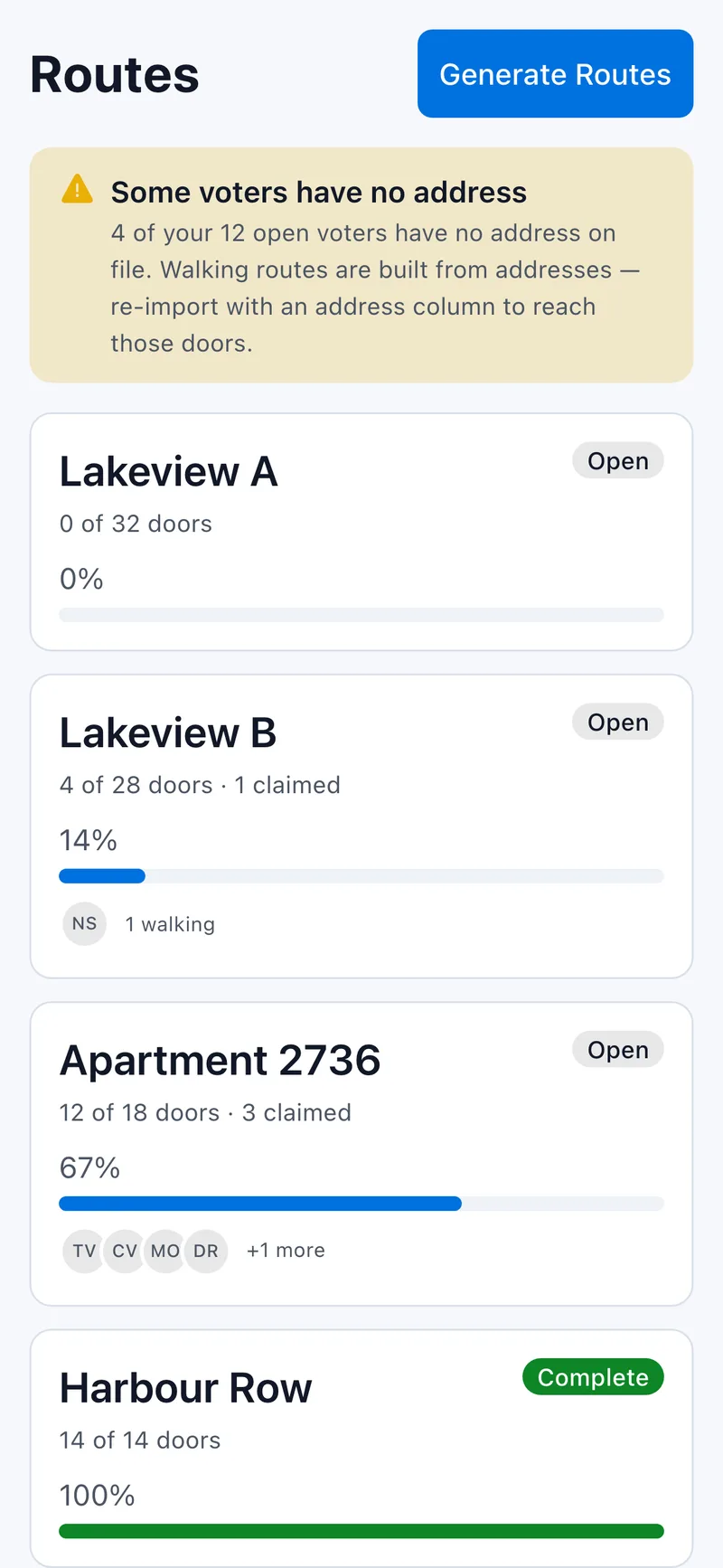
The Never reached and Not Home piles together are the doors the campaign still owes a visit. In Activate, a door marked Not Home stays on the remaining count until it has been tried 3 times, so those households flow back into routes without anyone rebuilding the list by hand. Activate groups nearby stops and splits them across your team automatically, which keeps 2 pairs from knocking the same door.
Three rules make the runoff pass better than the first one
- Change the time of day. A Not Home from a weekday evening gets a Saturday morning visit. The household that was out at 6 p.m. is often home at 10 a.m.
- Cut the streets that are finished. A block where every door is Yes, No or Skip gets no shift. Volunteers notice when they are sent to a street with nothing left.
- Size turf from your own pace. You know how many stops a pair finished on Nov 1. Use that number, adjusted for shorter daylight. The walk list guide shows the arithmetic.
Give your Yes answers a reminder pass
A Yes to your field question in October is a reason to visit once more in the runoff. The reminder carries 3 facts and takes about 30 seconds at the door: the runoff date, the early voting days and hours for that county, and where to look up a polling place. Your state election office publishes the lookup, and the county office publishes early voting locations. Use their links and leave the rest of the conversation to the resident.
Run this pass in the week before early voting opens, so the reminder arrives while the resident is still deciding when to vote. In Activate, routes, doors and phone banking cost nothing, while voter-file handling and texting use Credits you see before you confirm. A reminder works well by phone for Yes households on streets the door team will not reach. When to Canvass, Call, or Text covers which method fits which pile.
Work the calendar backward from early voting
Count back from the first day of early voting, not from runoff day. Here is a sample plan for a Georgia runoff, starting the week of Nov 9:
| Nov 9 | Restore and extend the campaign; sort the piles; recruit for the runoff | Shifts staffed for the next 2 weeks |
| Nov 16 | Never reached and Not Home doors, alternating evenings and weekends | Remaining count down by half |
| Nov 21 to 25 | Yes reminder pass on Saturday; early voting opens Monday | Every Yes household visited or called |
| Nov 27 to Dec 1 | Last Not Home pass on Saturday, Nov 28, then runoff-day reminders | Remaining doors given a final visit |
A Texas or Louisiana runoff on Dec 12 gets the same shape with about 10 more days: 2 full weeks of doors before early voting opens on Nov 28 or Nov 30, and the reminder pass on the weekend before.
Ask volunteers for fewer, firmer shifts
Runoff volunteers are the same people who just finished a campaign, and some of them will be traveling for the holiday. Ask for 2 specific shifts per person rather than open availability, and fill the Thanksgiving weekend first, because it is the hardest one to staff.
Keep the daily rhythm the general election taught you. A 10-minute end-of-shift debrief after each shift tells you which blocks are finished and which need another time slot. The manager dashboard updates as the team works, so the remaining count tells you each evening whether the plan is on pace.
A runoff plan fits on 1 page
By the end of your planning afternoon you should have the campaign restored with its end date on runoff day, the 5 piles counted, turf built from the doors still owed, a reminder plan for every Yes, and shifts placed against early voting. If your runoff list is new to Activate, set up the runoff campaign and bring your list; core canvassing is free, and the work your team does in the next few weeks lands on the same record as everything that came before.
¿Listo para comenzar la campaña?
Prepara tu campaña y empieza a tocar puertas en minutos. No se requiere tarjeta de crédito. Activate. ¡Hacia la victoria!
Iniciar Campaña Gratis