Free Canvassing App: The Whole Field Program Costs Nothing, 4 Services Meter
Activate leaves free whatever costs it nothing per campaign to deliver, and meters the 4 services that miss that bar — with a one-time 25-Credit grant that covers a first campaign's imports and its small data package.
Updated September 6, 2026
A campaign manager searching for a free canvassing app is asking a narrower question than the words suggest: which parts of this will still be free on the day the campaign gets busy. That is a fair thing to want answered before you import a voter file, so here is the boundary in Activate, drawn exactly where it sits.
Both halves of the answer are true at once. The whole field program — creating the campaign, getting volunteers onto it, assigning voters, generating routes, canvassing, watching the shift, exporting what you collected — costs nothing and needs no credit card. Metering applies to 4 things: SMS, AI column-mapping at import, secure handling of a voter-data package, and campaign messaging past the first 100. Every metered price is on screen before you confirm.
Your whole field program, from setup through export, runs at no cost
Nothing in the list below costs Activate anything per campaign to deliver, which is why none of it asks for a card. A manager building a school-board or city-council program can go from an empty account to volunteers at doors on this alone:
- Campaign creation and management — set up the campaign, the script, and the response definitions.
- Team invites — share 1 QR code or link. Canvassers join on their own phones with no app-store download. Codes are reusable, expire 30 days after they are created, and a manager can replace a code so the old link stops working immediately.
- No per-seat fee — team size stays a field decision.
- Voter assignment and tracking — every record is assigned to a specific canvasser.
- Route generation — Smart Distribution splits the list into routes so no street gets missed and nobody knocks the same door twice.
- Swipe canvassing — the mobile loop a volunteer actually uses at the door.
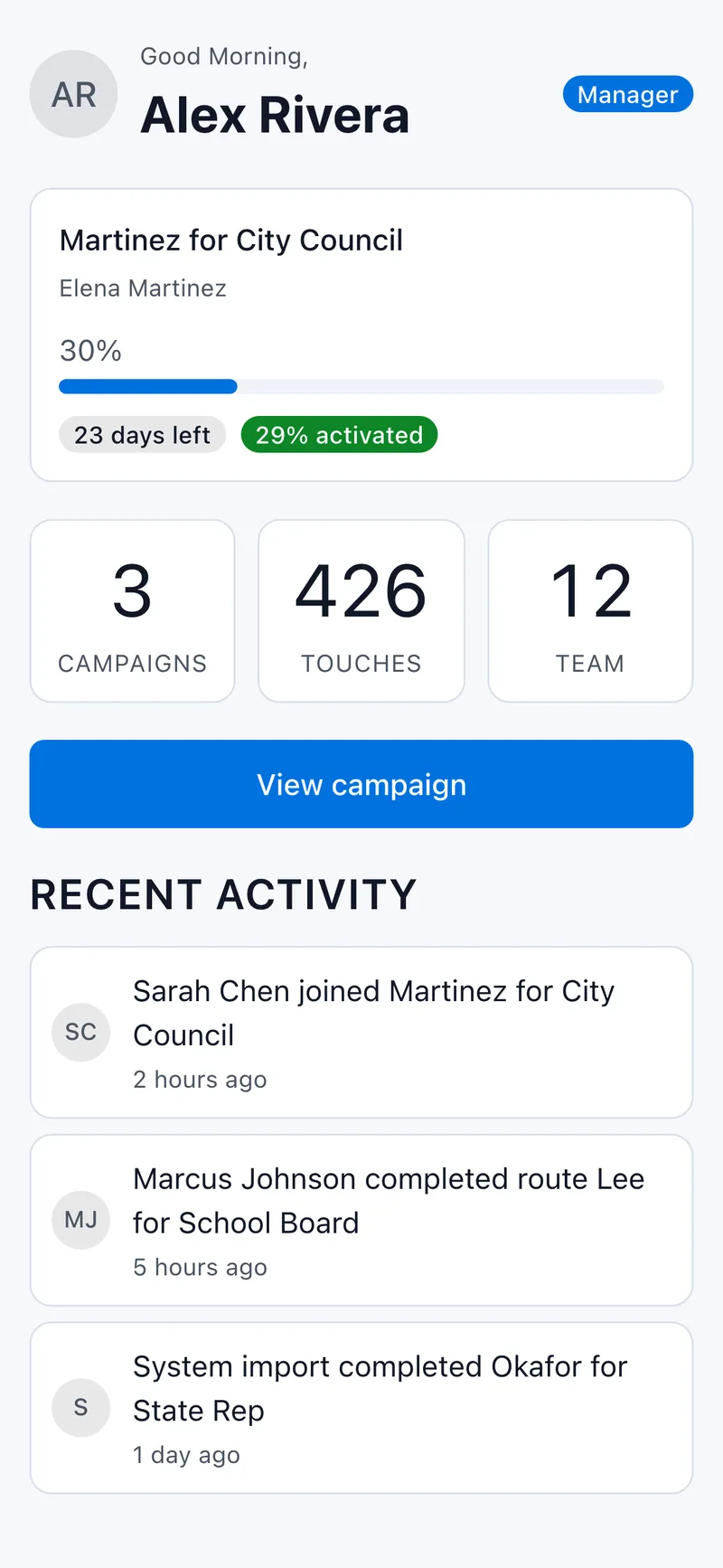
- The live manager dashboard — contacts and completion, updating automatically as the team works, so you can course-correct while the shift is still on.
- CSV export — your campaign data comes back out whenever you want it.
- The first 100 campaign messages — group and direct messages inside the campaign, free in every campaign before the meter starts.
Manual column mapping at import is free too. If you are willing to point Activate at which column holds the street name, you never pay for the mapping step — though the import itself still gets a handling quote, priced by package size in the next section. And your voter list is encrypted at rest with AES-256-GCM, is never sold or shared, and we can't decrypt it in bulk — that protection ships with every account.
The metered services put their price on screen before you confirm
Credits are one-off. 1 Credit is $1, there is no subscription, and nothing renews on its own.
SMS: 5¢ per segment. Texting voters is never free, because the carrier bills for every segment sent. Activate texts one-to-one from a campaign-managed number rather than blasting a list, and the compliance chain runs before a message leaves: carrier registration, consent, quiet hours, content screening, opt-out handling, and an already-contacted check. Phone coverage also varies a great deal by state — Activate shows how many voters in your list are reachable before you spend anything on reaching them.
AI column-mapping: 10¢ per import. A state voter file arrives with dozens of unlabeled columns — Ohio's public file carries 46, North Carolina's 70 — and matching them to what Activate needs is the slow part of an import. The optional AI step reads the headers and a sanitized sample — no voter PII goes to an AI service — and proposes the mapping. At 10¢ an import, skipping it costs nothing but your attention, and the 25-Credit grant below covers 250 of them.
Secure voter-data package handling: quoted by package size. Activate does not sell voter data and does not price per voter. What it charges for is the secure handling of a data package — encryption, normalization, storage, access — quoted from the size of the file before you confirm the import.
Campaign messaging past the first 100 messages: 1¢ each, batched so 100 messages equals 1 Credit. Every campaign gets its first 100 free, which is why messaging appears on both sides of this article: it is a metered service carrying a free allowance.
Your first campaign arrives with 25 Credits already in the balance
Every verified account receives 25 Credits once, after email verification. Creating another campaign does not trigger another grant. Campaign managers can use those Credits for AI column mapping, secure-package handling beyond the free allowance, and campaign messaging beyond the first 100 free messages. Only managers spend campaign Credits; SMS requires purchased Credits.
Grassroots campaigns typically bring a list small enough that the grant covers the handling quote, so a first campaign that is not texting often spends nothing beyond it. The metered half becomes a real line item when the campaign decides to text.
Smart Distribution is a deterministic address sort with no model in it
The routing story is short enough to tell in full. Smart Distribution treats route assignment as what it is — a deterministic proximity-and-capacity problem — because the field loop has to be fast, predictable, and auditable. Here is the whole sequence:
Two things the diagram leaves out. Grouping is what keeps an apartment building from landing as 40 scattered stops, and the chunking step prefers keeping a block contiguous over hitting a perfect route length. Coordinates are the rarer path — most voter files ship without latitude and longitude, and geocoding is a separate pre-canvass step, so most campaigns get the address sort.
It is also the reason routing sits on the free side: sorting addresses costs nothing per campaign, so there is nothing to bill for.
The free boundary follows marginal cost, so you can predict it yourself
The rule behind the free half runs in one direction only. Activate makes something free when the marginal cost of delivering it is near zero — software running against your own data. Sorting addresses, assigning voters, and rendering a dashboard cost nothing per campaign, so they cost you nothing.
The metered side runs on 3 different reasons. SMS is a straight pass-through: a carrier bills for every segment, and the 5¢ covers it. Secure package handling scales with the size of the file being encrypted, normalized, and stored. AI column-mapping and messaging past the first 100 are priced decisions rather than pass-throughs — both are cheap for Activate to run, and both sit on the professional side of the product rather than in the field loop everyone gets.
That is a boundary you can predict without reading a contract.
Pricing is one-off Credits against those metered services, at the rates listed on the full pricing page, and the campaign calculator turns a list size and an outreach plan into an estimate before you commit to either.
Settle the metered half before the volunteers show up
Almost every Activate budget comes down to 3 numbers: how many voters you are importing, whether you are texting them, and how many segments each message takes. Everything else is rounding.
Work it in that order. Import first and see the handling quote. Decide about SMS second, using the reachability count rather than the list size — a list of 5,000 voters with phone numbers on 1,200 of them is a 1,200-person texting program. Then load Credits once, for that program, rather than guessing early and holding a balance you did not need.
If you want the wider budget picture, what a local campaign actually pays for canvassing works through platform, participation, data, and staff-time costs as one worksheet. And when the money question is settled and the volunteers are showing up, the 30-minute launch sequence covers the part that decides whether the shift goes well.
The field program is free, the 4 metered services are priced in the open, and the whole boundary fits in your head after a single read. Take that into your budget meeting and the canvassing line comes out shorter than anyone expects.
Ready to start canvassing?
Set up your campaign and start canvassing in minutes. No credit card required. Activate. Toward Victory!
Start Free Campaign