Test a Neighborhood's Interest With a Door Survey
A worksheet for a business owner who wants to know whether a few streets want a service before opening or expanding there: one question, a block plan, a sample size and a decision rule set in advance.
Before a business signs a lease, adds a delivery zone or starts a service in a new neighborhood, it is making a bet about what the people on those streets want. A short door survey turns part of that bet into a reading. You ask one question at a few hundred doors, record the answers the same way every time, and compare what you hear with a threshold you set in advance.
This worksheet walks through the 5 decisions that make a door survey worth running: the question, the blocks, the number of answers, the decision rule, and how to read the results.
A survey asks; it does not sell
A door survey is a conversation about interest, and the doorstep is the wrong place for a pitch. Volunteers or staff ask the question, record the answer, thank the resident and move on. No order forms, no prices, no sign-ups for a sales call.
That boundary protects 2 things. It keeps the answers honest, because people answer a question differently when they sense a pitch behind it. And it keeps the visit welcome, which matters when these are the streets you hope to serve. If residents want to hear when you open, leave a card with a way for them to reach you, so contact starts on their side.
Before the first shift, check the rules where you will knock. Your city or county may require a permit for door-to-door visits or keep a list of addresses that do not want them. Those rules belong to the business running the program, and the city clerk's office is the place to ask.
Write 1 question that a stranger can answer in 5 seconds
The question decides whether the answers mean anything. Four rules
- One idea. "Would you use a laundry pickup service on this street?" asks one thing. "Would you use pickup, and would you pay for same-day?" asks two, and a Yes cannot tell you which.
- Yes or No is a real answer. Write it so both answers are easy to say out loud and easy to record.
- The service, not the brand. Ask about the thing you would offer. Your name means nothing to the resident yet.
- A concrete frame. "In the next 6 months" or "within walking distance" makes the answer about real behaviour.
Here are 3 worked examples from different kinds of business, to show the shape:
| A tutoring center choosing a second site | "Would a tutoring center within walking distance be useful to your household this school year?" |
| A landscaping service adding a route | "Would you consider a weekly lawn and leaf service for this home next spring?" |
| A cafe weighing early hours | "Would you stop for coffee on this block before 7 a.m. on weekdays?" |
Agree with your team on what counts as Yes before the first shift. "Maybe, depends on the price" is a No for this question, with a note.
Choose blocks that match the decision
Survey the streets your decision is about. If you are choosing between 2 sites, pick blocks within the realistic reach of each site, such as a 10-minute walk or a 1-mile drive, and survey both the same way. If you are deciding whether to extend a service area, survey the blocks just beyond your current edge.
Start from a list of addresses your business is permitted to use for this program, such as your own customer records or a residential address list for those blocks from a source whose terms allow door visits. Official voter files serve election work only, so leave them out of a business survey.
Decide how many answers make a reading
What matters is the number of doors that answer, not the number you knock. With 100 answers, a Yes share of 30% is a reading with a margin of about 9 points either way at the usual 95% confidence. With 50 answers the margin grows to about 13 points, and with 200 it shrinks to about 6. That is plain arithmetic for a random sample, and a door survey is not a random sample, so treat the margin as the smallest uncertainty you have.
Work backward from the answers to the doors
| Answers you want per area | 100 |
| Share of doors that answer, from your first shift | ÷ 0.35 = about 290 doors |
| Doors a pair finishes in a 3-hour shift | ÷ 50 = about 6 pair-shifts |
| Areas you are comparing | × 2 = about 12 pair-shifts |
Every number above is illustrative. Your first shift gives you your own answer rate and pace; use them for the rest of the plan.
Write the decision rule before the first knock
Decide in advance what result would change your plan, and write it down. For example: "If at least 25% of answered doors in an area say Yes, we take the lease there. If both areas clear 25%, we choose the higher one. If neither does, we wait." A rule written after the results arrive tends to bend toward the answer you hoped for.
Read Yes, No and Not Home for what they are
Each visit records Yes, No, Not Home or Skip, plus notes. Read them in this order:
- Yes share = Yes ÷ (Yes + No). This is your reading, per area. Not Home and Skip are not part of it.
- Answer rate = (Yes + No) ÷ doors knocked. A very low answer rate means the reading rests on a small, unusual group. Revisit Not Home doors at a different time of day before you trust it.
- Notes. Look for patterns: the same condition attached to many Yes answers, or a reason repeated across the No answers. Notes explain the share; they do not change it.
A doorstep answer is a statement of interest, not a purchase. Treat the Yes share as an upper bound on demand, and compare areas with each other rather than reading one number in isolation.
Running the survey in Activate
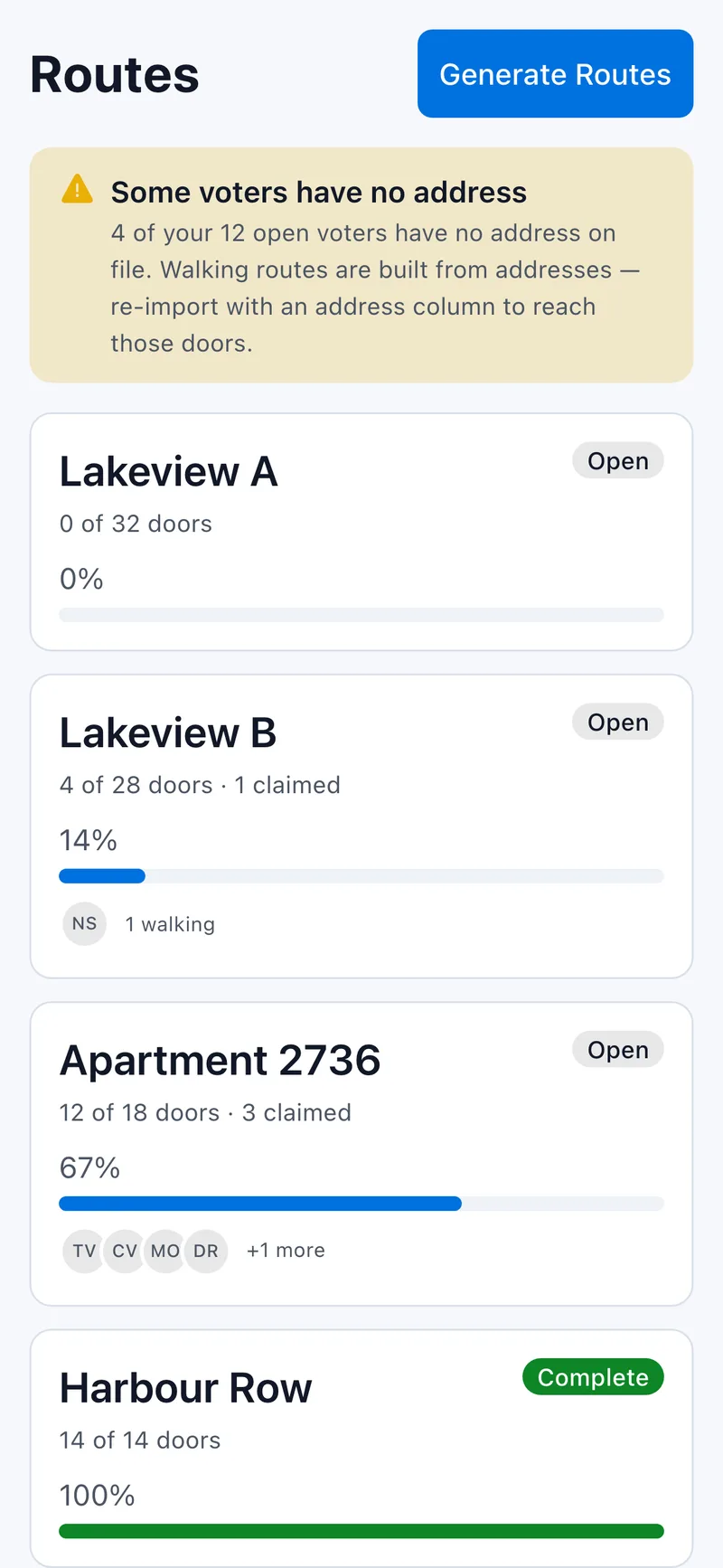
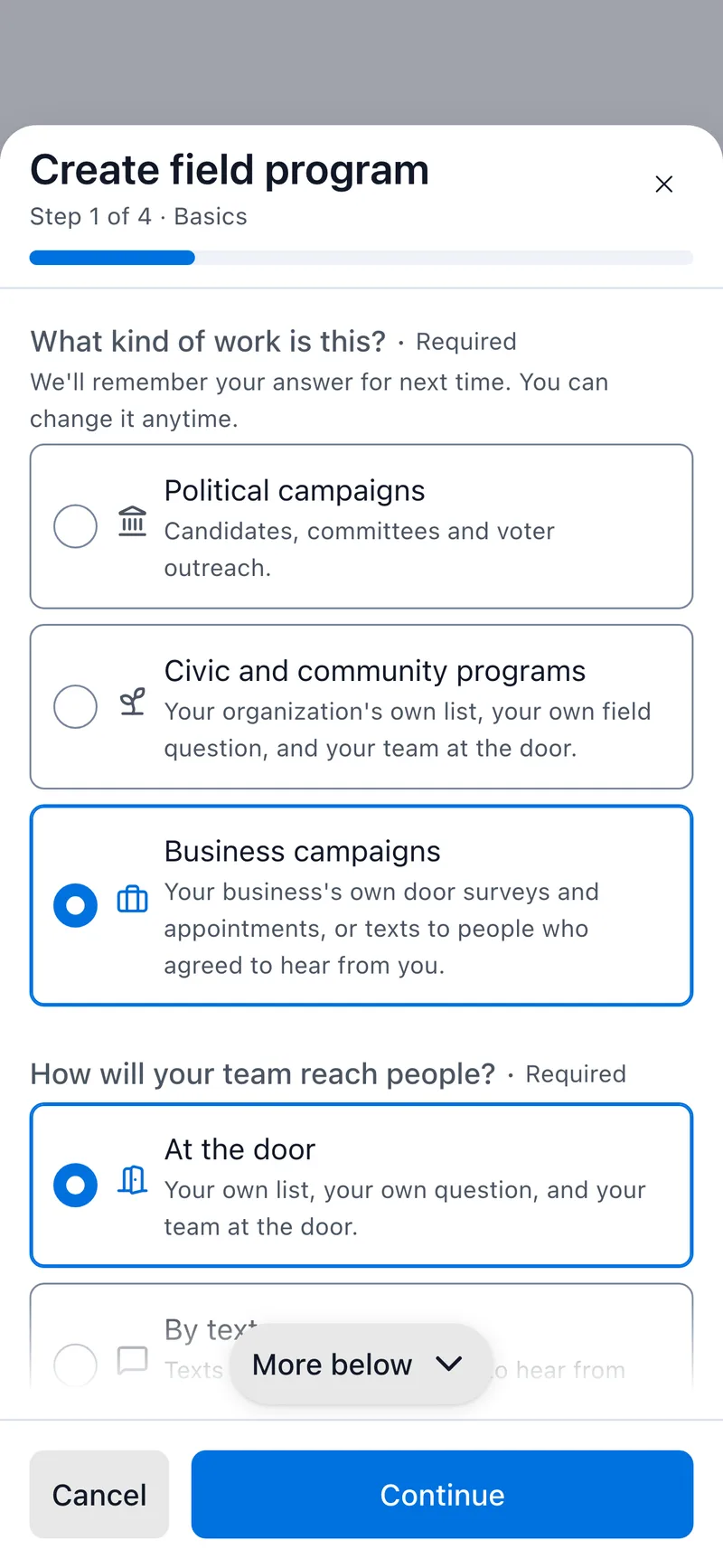
To run the survey in Activate, create a campaign, choose Business campaigns and then At the door, upload your list and write your field question. Invite your team with a QR code, and canvassers join in seconds, no app store. Unlimited canvassers, no per-seat fee — team size stays a field decision. Activate groups nearby stops and splits them across your team automatically.
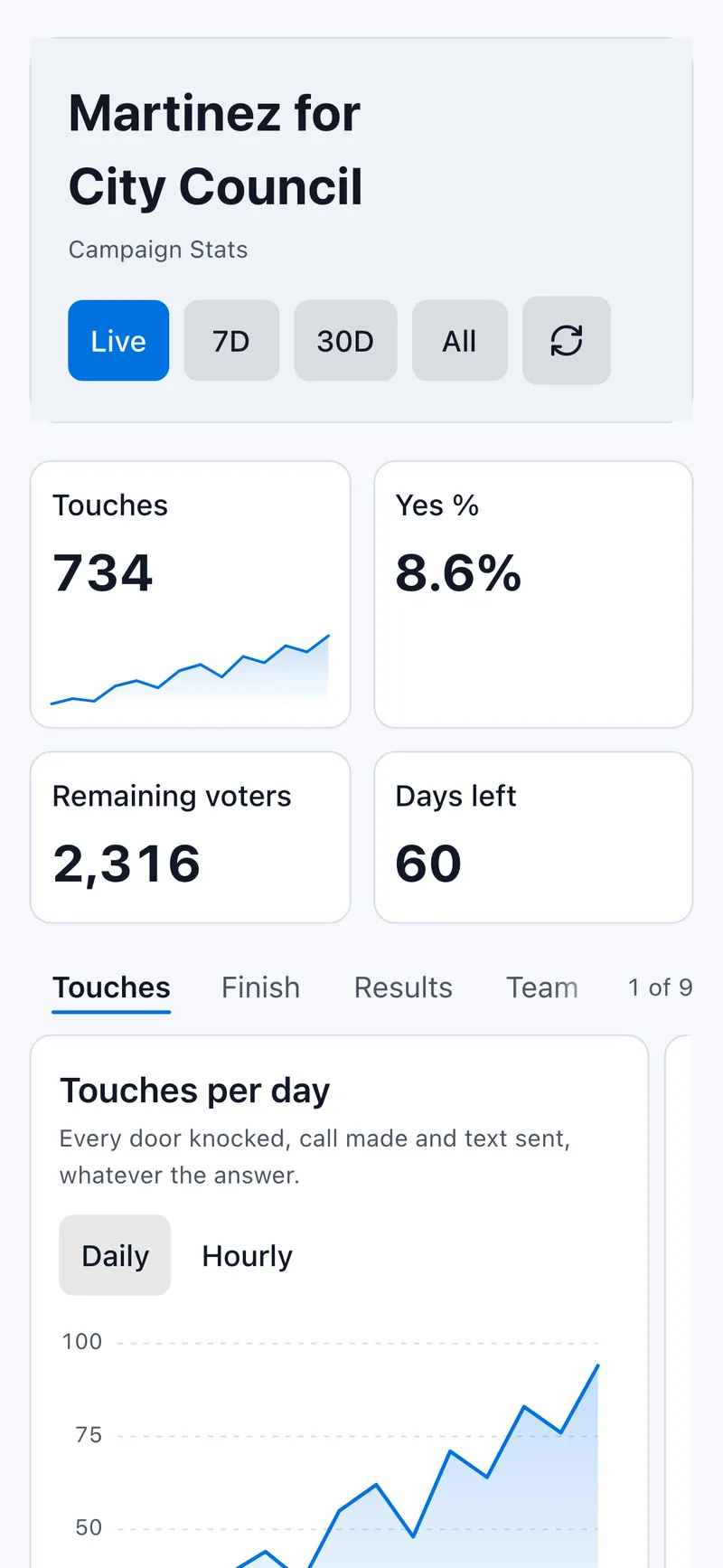
The manager view is a live dashboard that updates automatically as your team works, so you can see the answer count climb toward your target during the shift. When the survey is done, export the program's data as CSV for your own records and the next round of visits, and calculate the Yes share per area in a spreadsheet. The business door surveys page walks through setup step by step, and the end-of-shift debrief keeps each round of visits improving the next.
A reading you can act on
A good door survey ends with a sentence you could defend to a partner or a lender: we asked 1 question at 290 doors in each area, 100 answered in each, and the Yes share was 34% in one and 18% in the other, against a threshold we set at 25%. If you have a decision like that coming up, set up your door survey and let the street answer before you sign.
Ready to start canvassing?
Set up your campaign and start canvassing in minutes. No credit card required. Activate. Toward Victory!
Start Free Campaign