Your First 100 Conversations: A Learning Sprint Without Fooling Yourself
A disciplined early-field review that separates attempts, contacts, conversations, outcomes, and follow-ups without treating selected canvassing data as a poll.
Updated September 20, 2026
The first encouraging canvass can make a campaign feel ten feet tall.
The first difficult canvass can make the same campaign feel finished.
Neither feeling is a measurement.
Early field data is valuable because it helps a campaign improve assignments, timing, training, follow-up, and volunteer support. It is dangerous when a handful of targeted doorstep conversations becomes a declaration about the entire electorate.
So treat the first 100 meaningful conversations as a learning sprint: large enough to expose operational patterns, small and selected enough to demand humility. The number 100 is an organizing example—not a product limit, magic sample size, or guarantee of statistical significance.
What field data can answer
Your first wave can help answer
-
- Are volunteers beginning their assignments?
-
- Are the addresses workable?
-
- When are residents answering?
-
- Does the opening question produce a conversation?
-
- Are response labels understood consistently?
-
- Which issues require researched follow-up?
-
- Where does the field process slow down?
-
- Do volunteers feel prepared and supported?
Those are operational questions about the campaign’s selected universe, turf, time, and team.
What it cannot answer by itself
The first 100 conversations cannot reliably tell you
- who will win;
- the support level of the full electorate;
- how people who did not answer would respond;
- whether one precinct represents the jurisdiction;
- whether a result will persist until Election Day; or
- whether the canvass caused an observed opinion.
Representative polling uses sampling and weighting methods intended to estimate a broader population. The Pew Research Center explains that even properly designed poll estimates carry sampling uncertainty, while weighting and other sources of error also matter.
Canvassing records are not a random sample. They reflect who was targeted, who was attempted, who answered, who spoke, and how the volunteer recorded the exchange.
Field data can tell you what happened in the operation. It should not dress up as a poll.
Build the seven-line scorecard
Use one definition set across every shift
- Assigned: Records provided to the team.
- Attempted: Doors where a legitimate contact attempt occurred.
- Reached: Someone appropriate answered.
- Meaningful conversations: The campaign’s central question or purpose was actually discussed.
- Resolved outcomes: The result fits a defined support or disposition category.
- Follow-ups: A specific campaign action is required.
- Complete records: Attempts were logged with the required fields.
Then calculate
- attempt rate = attempted ÷ assigned;
- contact rate = reached ÷ attempted;
- conversation rate = meaningful conversations ÷ reached;
- resolution rate = resolved outcomes ÷ meaningful conversations;
- follow-up rate = follow-ups ÷ meaningful conversations; and
- data completion rate = complete records ÷ attempted.
The denominator matters. “Thirty supporters” means something different after 60 attempts than after 600.
Compare like with like
Do not compare two volunteers or turfs without context.
Record
- date and time;
- weather and daylight;
- housing type;
- travel distance;
- building access;
- turf size;
- volunteer experience;
- candidate presence;
- script version; and
- unusual events.
An apartment route and a rural route do not offer the same attempts per hour. A weekday afternoon and a Saturday morning may produce different contact rates. An experienced candidate and a first-time volunteer may have different conversation patterns.
Context does not make comparison impossible. It makes comparison honest.
Read stories beside numbers
Hold a 20-minute review after each wave.
Minutes 0–5: Read the scorecard
Look for one unexpected rate—not the number that flatters the campaign most.
Minutes 5–10: Ask volunteers what happened
Use three questions
- Where did the process get in your way?
- What did residents ask that we were not ready to answer?
- Which part of the conversation felt natural or unnatural?
Minutes 10–15: Match stories to records
If volunteers say nobody was home, inspect the contact rate. If conversations felt strong but outcomes are missing, inspect completion and definitions. If one issue appeared repeatedly, count the relevant follow-ups without assuming prevalence beyond the contacted group.
Minutes 15–20: Choose one change
Possible changes include
- a different launch explanation;
- revised response definitions;
- another time of day;
- a shorter opening;
- better apartment access preparation;
- a researched FAQ answer;
- clearer follow-up ownership; or
- redistributed turf.
Change one major variable when practical. If the script, timing, turf, training, and data categories all change at once, the next result will be different—but the campaign may not know why.
Use the live dashboard as a support tool
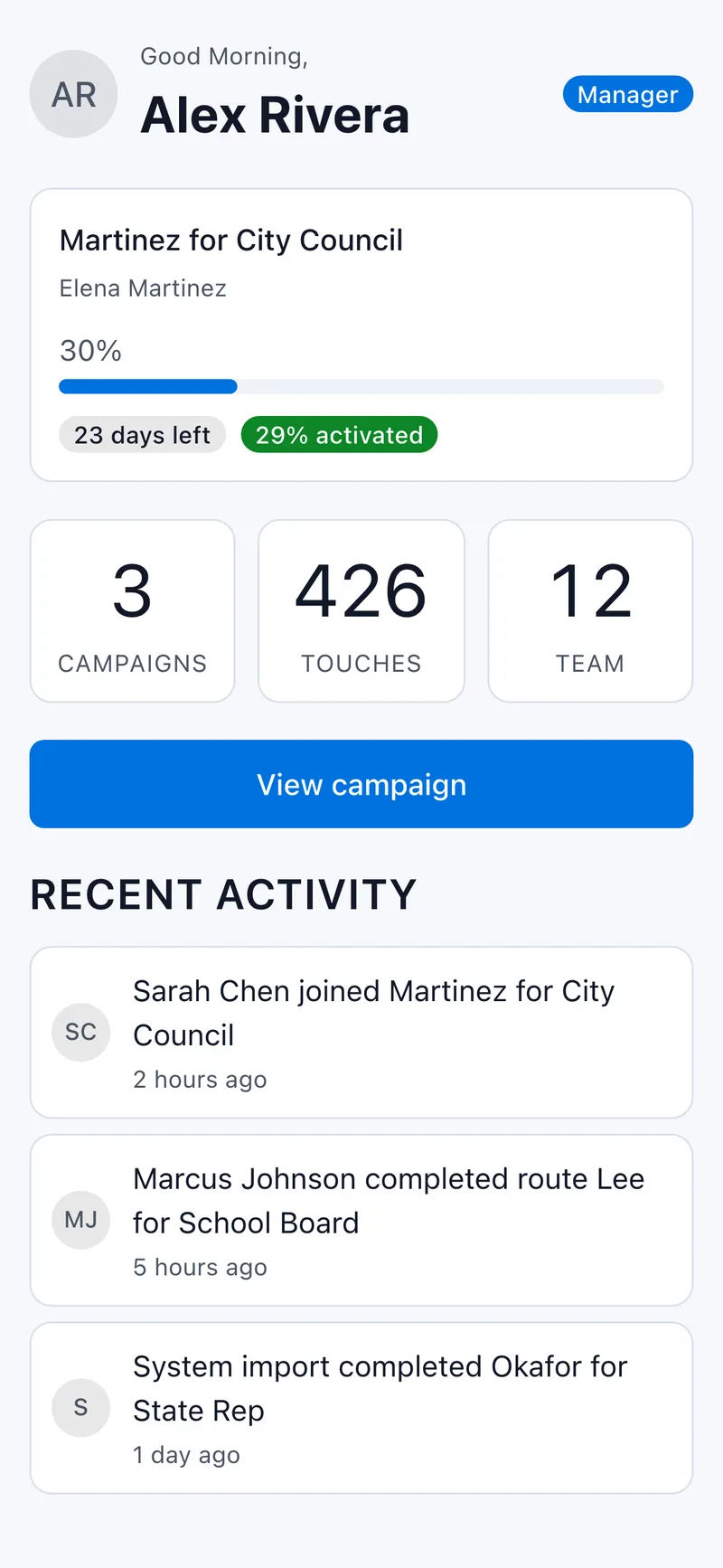
With Activate, unlimited canvassers can contribute to the same campaign with no per-seat fee — team size stays a field decision. Completion rates, response breakdowns, and team activity update while the field is moving.
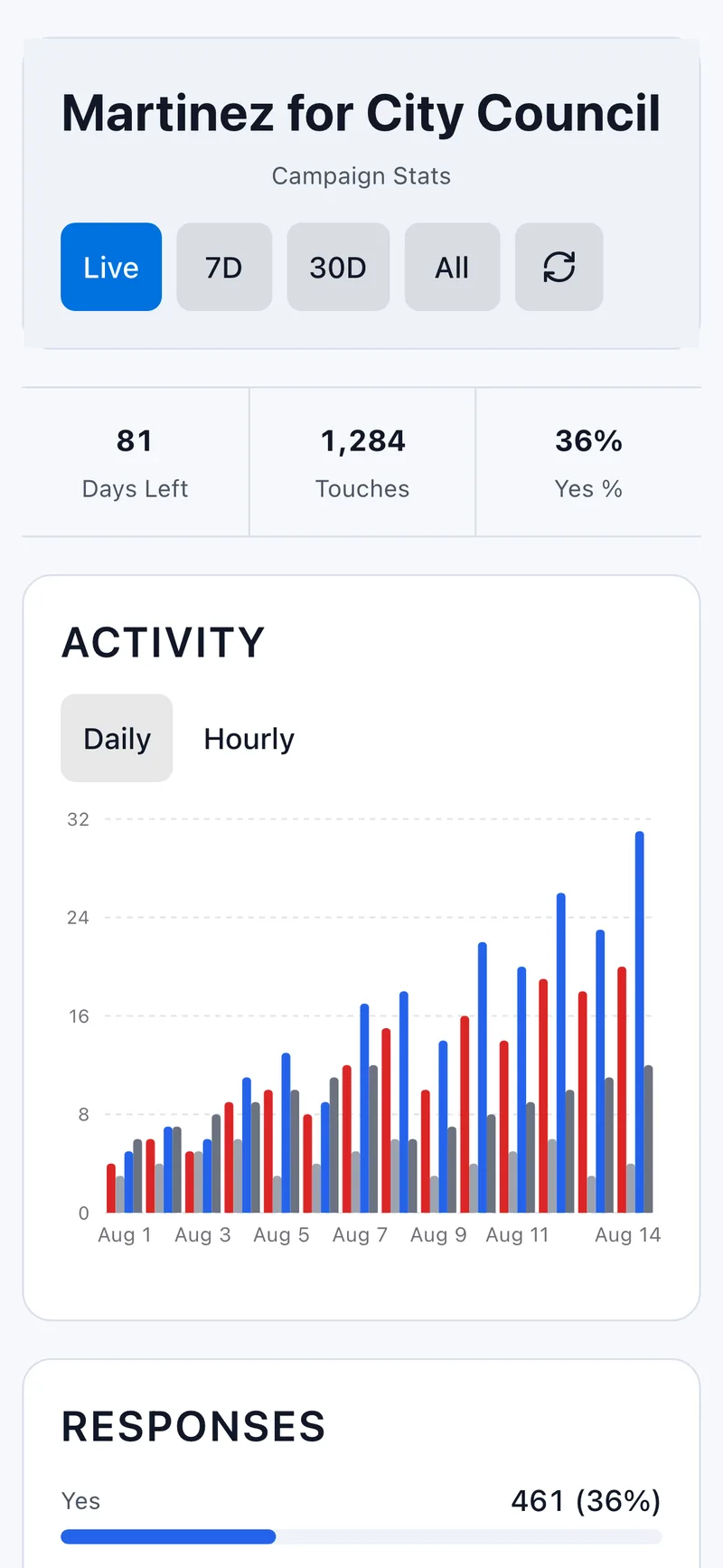
That creates an opportunity for timely support
- call a volunteer whose route appears blocked;
- clarify a response label being used inconsistently;
- move available help toward unfinished turf;
- prepare an answer to a recurring question; or
- recognize a team that completed difficult work accurately.
The dashboard should be a flashlight, not a hammer. Raw totals should not become a public ranking detached from assignment difficulty, contact opportunity, or volunteer experience.
A decision table for early data
| Low attempt rate | Is turf or onboarding slowing the team? | Inspect routes and launch | Voters are uninterested |
| Low contact rate | Were timing or access unusual? | Test another period | The message failed |
| Low conversation rate | Does the opening invite a reply? | Practice and revise | The candidate is unpopular |
| Many follow-ups | Are questions recurring? | Assign answers and owners | All voters share the issue |
| High support among contacts | Who answered and where? | Plan appropriate follow-up | The campaign leads jurisdiction-wide |
| Missing records | Is logging unclear or cumbersome? | Retrain and simplify | Unlogged doors had a particular outcome |
Early data should lead to better questions before it leads to bigger claims.
Protect the learning record
Record only what the campaign is authorized to use and needs for field or follow-up. Avoid speculative labels, unnecessary sensitive notes, and conclusions about a person who did not speak.
Define “not home,” “refused,” “undecided,” and “follow up” before the sprint. Remove access when a volunteer leaves. Keep exports controlled. A learning system becomes unreliable when accuracy and privacy are treated as optional.
The sprint review
After the first 100 meaningful conversations—or another clearly labeled milestone—write one page:
- What we attempted
- What we reached
- What we learned operationally
- What residents asked
- What we still do not know
- What one change we will test
- Who owns every follow-up
The sentence “what we still do not know” may be the most valuable line.
A local campaign does not need to ignore early evidence. It needs to use early evidence for the decisions that evidence can actually support.
For the live operational decisions behind the scorecard, read When One Canvasser Taps “Yes,” the Whole Campaign Should Know. For the complete field learning loop, continue with The Door Is Not the Goal.
If your campaign is ready to run its first learning sprint, start a free campaign with Activate. Invite the team, watch the field develop in real time, and make the next shift smarter without pretending the first shift predicted Election Day.
Toward Victory!
Sources and further reading
- Pew Research Center, “Understanding the Margin of Error in Election Polls.”
- Donald P. Green, Alan S. Gerber, and David W. Nickerson, “Getting Out the Vote in Local Elections: Results from Six Door-to-Door Canvassing Experiments,” The Journal of Politics 65, no. 4 (2003).
Ready to start canvassing?
Set up your campaign and start canvassing in minutes. No credit card required. Activate. Toward Victory!
Start Free Campaign