When One Canvasser Taps “Yes,” the Whole Campaign Should Know
Why accurate, secure, real-time canvassing data helps campaigns understand volunteers, compare precincts, shift targets, and act while the field is still moving.
Updated September 21, 2026
“Yes” is a small word.
At a front door, it might mean: Yes, I support the candidate. It might mean: Yes, I need voting information. It might even mean: Yes, I will put a sign in the yard, make a call, or join the next canvass.
But once that answer is recorded, it should become more than a pleasant moment between one volunteer and one voter. It should become useful knowledge for the whole campaign.
When a canvasser taps Yes, a campaign manager should not have to wait for a clipboard, a spreadsheet, a text-message recap, or an end-of-night huddle to learn what happened. The result should appear while the team is still walking the neighborhood—because a campaign can only act on information it can see.
That is the real importance of campaign data. It turns motion into judgment.
Data tells you whether the work is becoming a campaign
A busy field office can be wonderfully loud. Phones ring. Literature gets stacked. Volunteers arrive carrying coffee, questions, and exactly one glove they cannot explain.
Activity feels like momentum. Sometimes it is. But activity alone cannot answer:
-
- Which volunteer is reaching the most voters?
-
- Which volunteer is having the highest rate of meaningful conversations?
-
- Which precinct is producing the strongest support?
-
- Which turf has many attempts but very few answers?
-
- Where are undecided voters asking for follow-up?
-
- Is the current target universe still the best use of the next two hours?
Those are data questions.
Political-science research repeatedly shows why the distinction matters. A 2024 meta-analysis of voter-mobilization tactics emphasized intent-to-treat effects—results across everyone a campaign tries to contact—because declining contact rates can substantially reduce the overall effect of a tactic. A brilliant doorstep conversation cannot help a voter who was never reached. A large door count can therefore conceal a weak contact rate.
Good field data separates the layers: assigned, attempted, reached, meaningfully engaged, resolved, and ready for follow-up.
A live field stream is better than a poll—for a different question
Campaigns need polls. A well-designed survey estimates opinions among a broader population and reports uncertainty. The Pew Research Center notes that a poll's margin of error describes how much estimates could vary across repeated samples, while other sources of error may also affect results.
Canvassing data is not a representative poll, and a campaign should never pretend that it is. People who answer the door may differ from people who do not. Targeted turf is not the entire electorate. A support result recorded by a volunteer is not a secret ballot.
But a live field stream can be better than a poll for the operational question standing in front of a campaign manager:
What is happening in our target universe, on our turf, with our volunteers, right now?
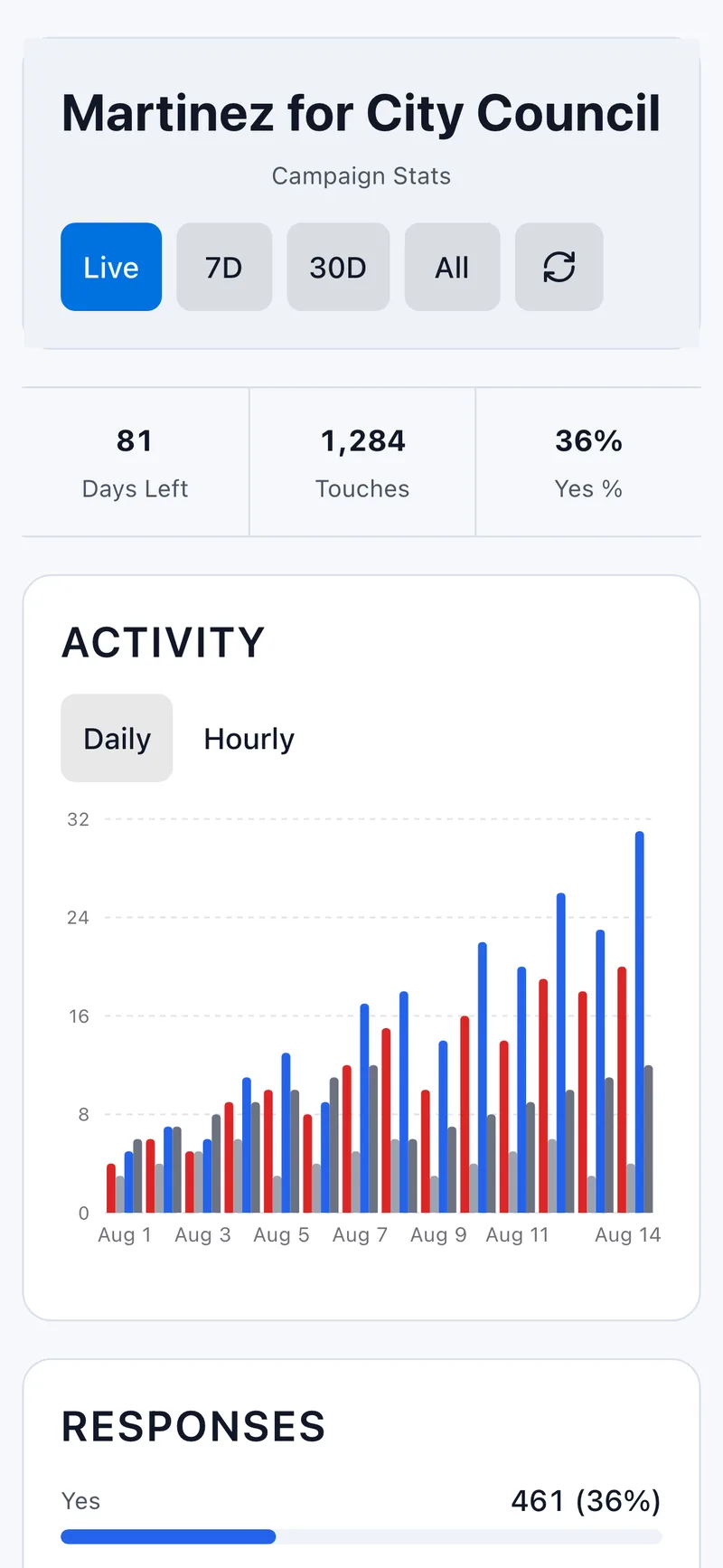
A poll may suggest where a race stands. Live canvassing data can show whether Precinct 14 is answering at twice the rate of Precinct 9, whether one walk list is nearly complete, whether a volunteer team needs help, or whether a cluster of new supporters merits a second contact.
One tool estimates the weather. The other tells you whether it is raining on this block.
Every canvasser should strengthen one campaign
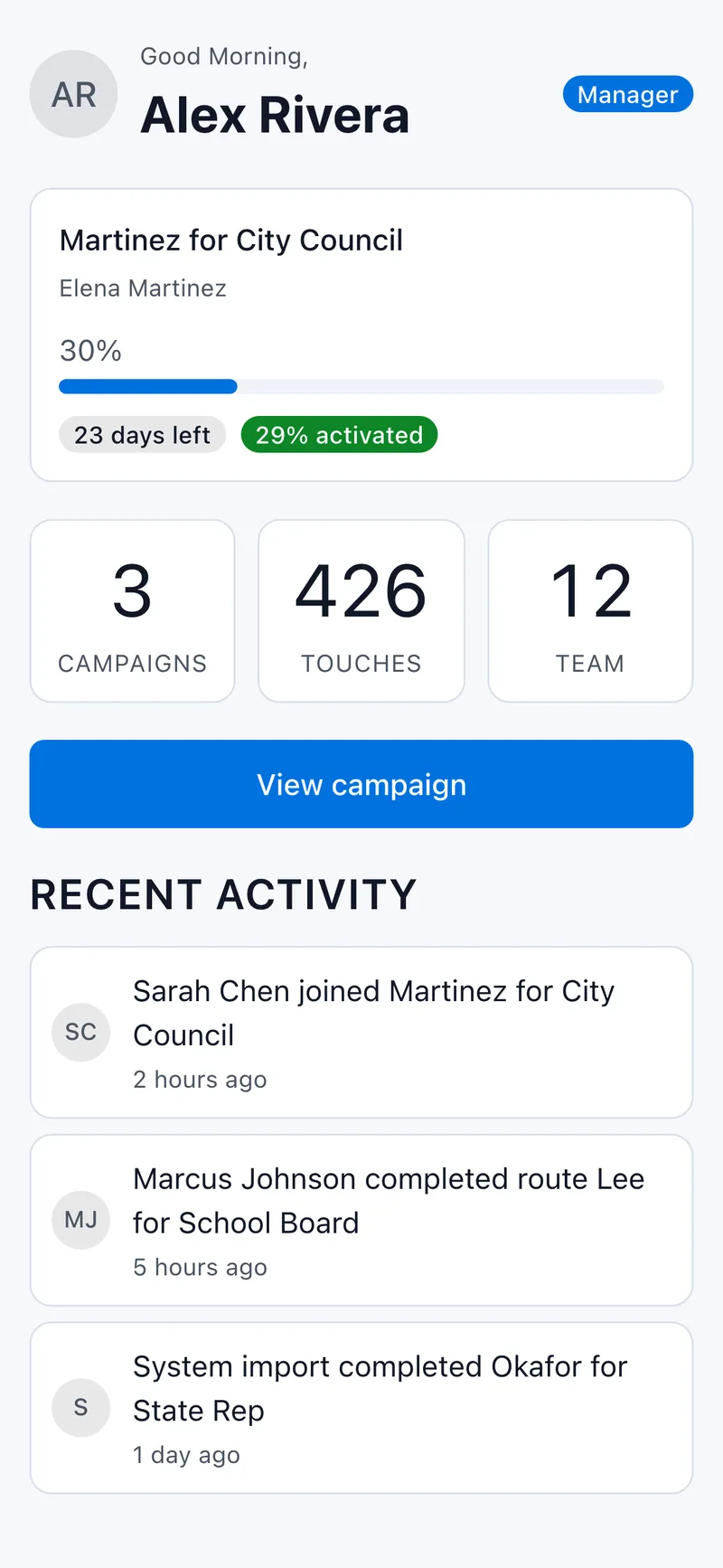
When every canvasser works inside the same campaign, each phone becomes a window into one shared field operation.
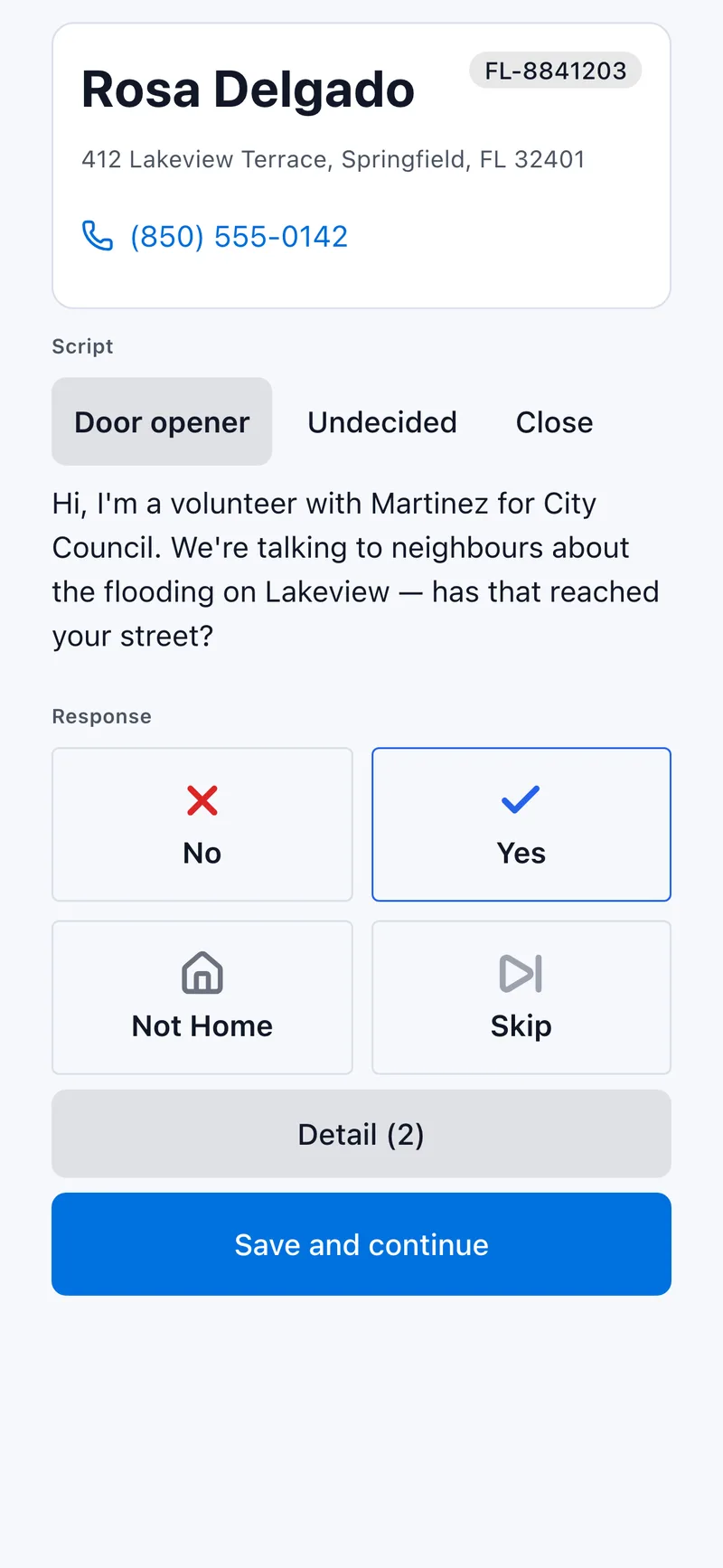
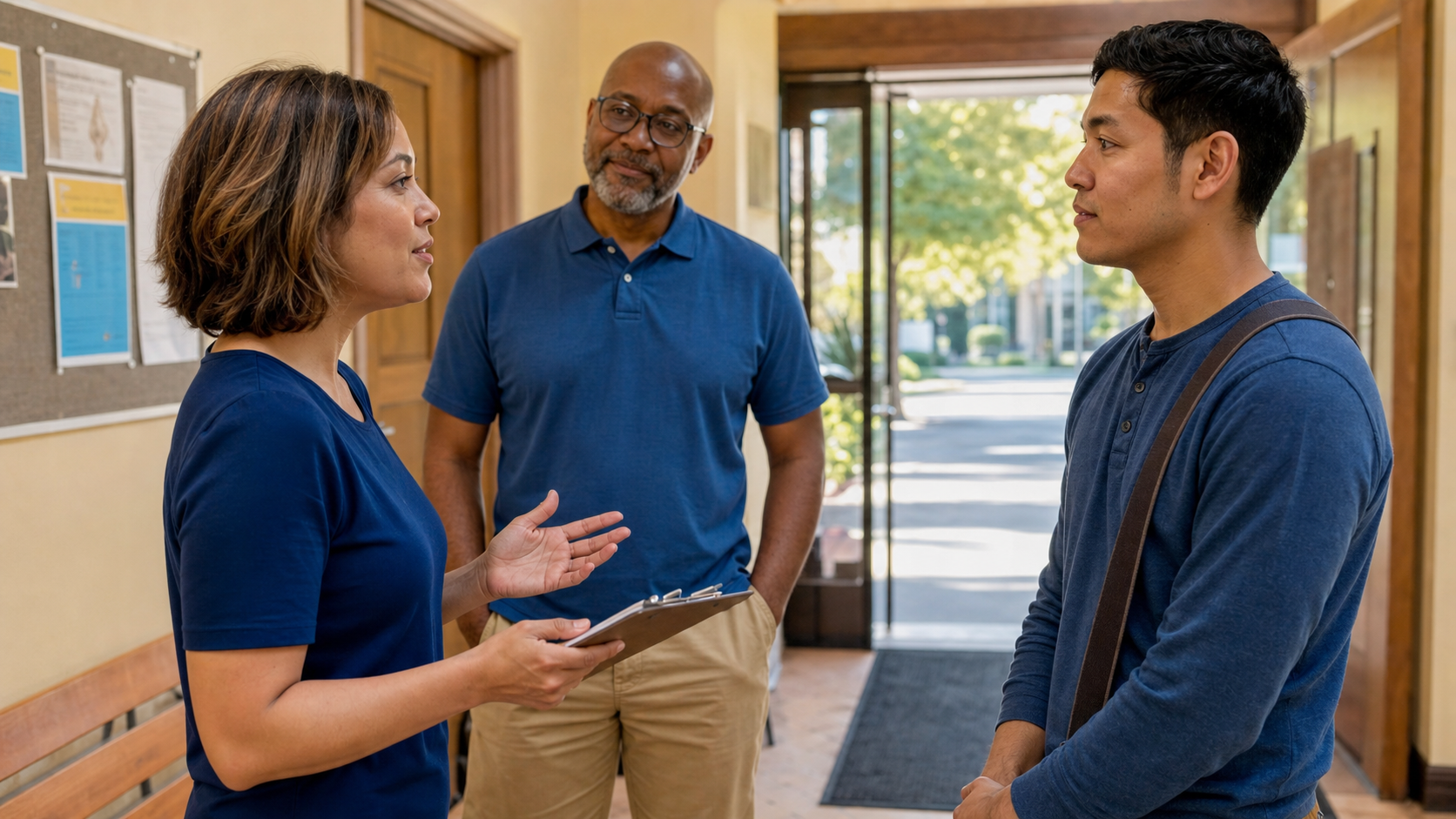
Whether a campaign fields a handful of canvassers or hundreds, every result can strengthen the same live campaign. Image created for Activate.
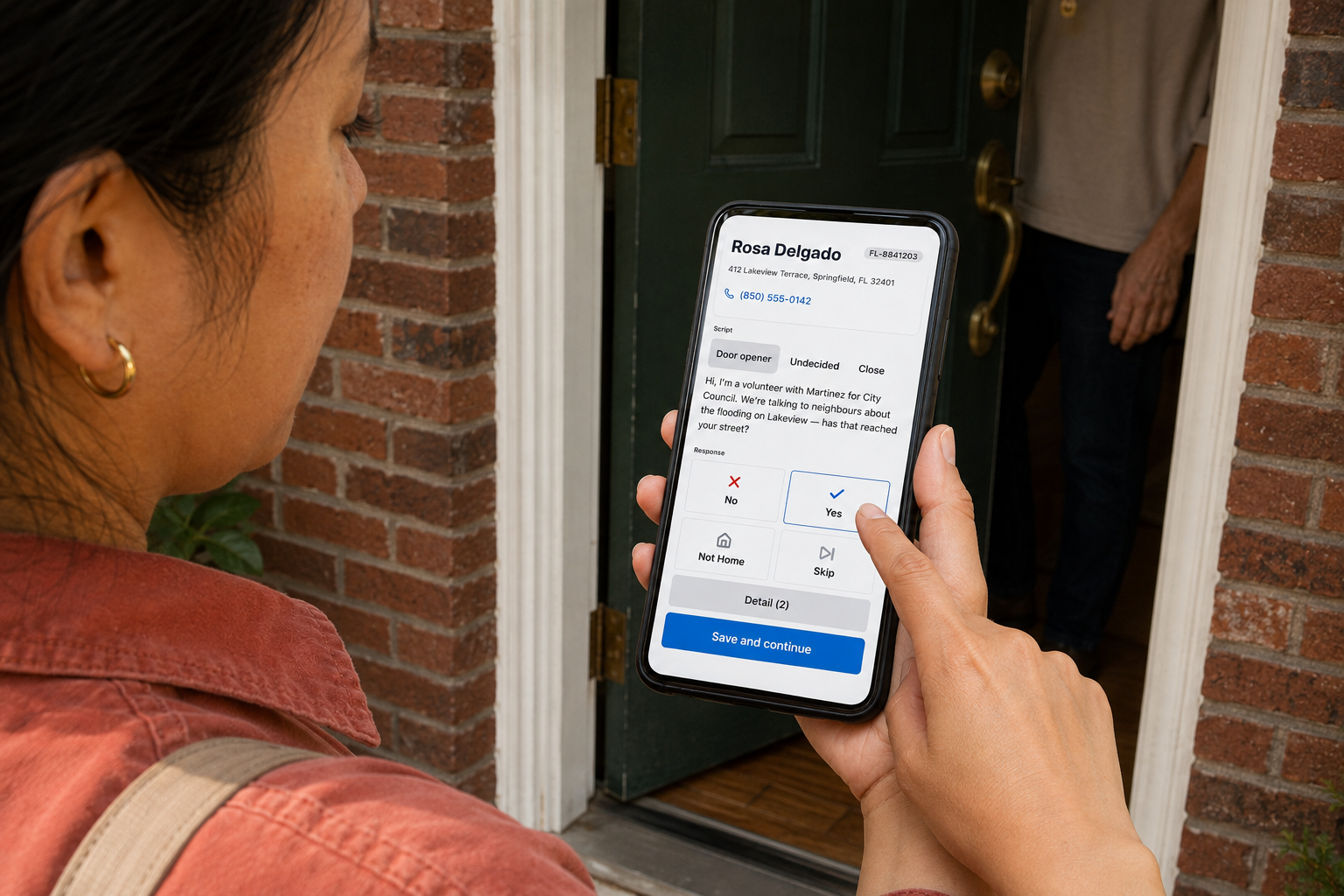
In Activate, canvassers join a campaign by QR code or link and record Yes, No, Skip, or Not Home with thumb-friendly controls. Results feed a live dashboard with completion rates, response breakdowns, team activity, and a canvasser leaderboard.
The important part is not how many phones are connected. Activate supports unlimited canvassers with no per-seat fee — team size stays a field decision, so a campaign does not have to ration participation as its volunteer operation grows. Every connected canvasser makes the shared picture clearer—and gives campaign leadership more timely information for the next decision.
A campaign manager can watch the operation become legible one result at a time.
What live canvassing data can reveal
1. Which volunteers are moving the work forward
A leaderboard can show attempts, completions, or other campaign activity. That does not mean the person with the highest number is automatically the “best” volunteer.
One route may contain apartment buildings while another contains long rural driveways. One volunteer may be assigned a high-contact neighborhood while another is training a first-time canvasser. Context matters.
Still, performance data is useful. Four field experiments involving 158 political campaign volunteers found that a simple achievement-oriented visual prompt increased the number of address-contact attempts compared with no prompt. The larger lesson is not to decorate every office wall. It is that volunteer behavior can respond to management choices—and campaigns can measure the difference.
Use performance data to
- recognize strong work;
- pair experienced and new canvassers;
- identify a volunteer who is stuck;
- learn which training produces clearer records;
- compare similar assignments fairly; and
- ask high-performing volunteers what is working.
A leaderboard should be a flashlight, not a hammer.
2. Which precincts are strongest—and which are merely busiest
Suppose one precinct records 80 supporters from 400 attempts. Another records 55 supporters from 150 attempts.
The first precinct has more total supporters. The second has a much higher supporter yield among attempts. Neither number is sufficient alone.
A useful precinct view combines
- total assignments;
- attempts;
- contact rate;
- support rate among contacts;
- undecided or follow-up rate;
- completion rate; and
- time required to work the turf.
That combination helps a campaign distinguish a true area of strength from a precinct that simply received more volunteer hours.
3. Where the campaign should go next
Targeting should not be a plan written once and admired for the rest of the election.
If a precinct has high support but low completion, send another team. If a turf has many unanswered doors, return at a different time. If a neighborhood generates many requests for information, prepare a focused follow-up. If one route is complete and another is stalled, redistribute the next available volunteers.
Smart distribution and real-time results make those changes possible before the day is over. That is the operational advantage: the information arrives while the campaign still has choices.
4. Whether the message is being understood
A simple support response is useful. A support response connected to an issue or question is more useful.
When the same concern appears across multiple doors, the campaign may need a researched answer, an updated FAQ, a candidate video, or a follow-up script. The purpose is not to tell every voter whatever they want to hear. It is to recognize what the community is asking and respond accurately.
Campaign data should make listening cumulative.
Bad data moves quickly, too
Real-time systems do not magically make information accurate. They make whatever is entered available faster.
If volunteers use Skip to mean three different things, the dashboard will produce a precise picture of an undefined category. If someone records a resident as opposed when nobody answered, the campaign may remove a persuadable voter from future contact. If five canvassers forget to log their final street, completion rates become misleading.
Before a canvass begins, define every response
- Yes: the voter gave a clear affirmative answer to the campaign's defined support question.
- No: the voter gave a clear negative answer—not merely that they were busy.
- Not Home: no meaningful contact occurred.
- Skip: the assignment could not be completed for a defined reason.
- Follow Up: the voter requested information or another campaign action.
Campaigns should also distinguish attempted from contacted. Research on canvassing repeatedly demonstrates that contact rate is a limiting factor. If those two events are blended together, the campaign cannot learn whether the problem is targeting, timing, turf, training, or message.
Speed matters. Definitions make speed trustworthy.
Political data deserves serious protection
Campaign information is not just rows and colored dots. It can include names, addresses, contact history, issue interests, language needs, and volunteer notes. The U.S. Election Assistance Commission explains that voter-file availability and contents vary by state and that voter files do not reveal whom a person voted for. State rules also vary regarding permissible access and use.
That means a campaign should collect only what it is authorized to use, limit access, train volunteers, and avoid casual exports to personal spreadsheets or devices.
Activate protects imported voter data with AES-256 encryption at rest. The phrase matters because encryption at rest protects stored information when it is not actively moving through the system. The National Institute of Standards and Technology's Advanced Encryption Standard is the federal standard behind many modern confidentiality protections for sensitive, unclassified data.
Encryption is a foundation, not an excuse to become careless. A responsible campaign should still:
- give access only to people who need it;
- use strong, unique account credentials;
- train volunteers not to photograph or copy voter records;
- avoid collecting unnecessary sensitive notes;
- follow applicable voter-file, privacy, and campaign laws; and
- remove access when a volunteer leaves the campaign.
Trust is part of field strategy. People should not have to trade their privacy for participation.
A five-minute decision test
Imagine it is 5:10 p.m. Three canvassing teams are outside. Ninety minutes of daylight remain.
The dashboard shows
- Team A has completed nearly all of its turf and is recording a strong contact rate.
- Team B has attempted many doors but reached very few people.
- Team C has found a pocket of supporters in a precinct that is only half complete.
Without live data, the manager may learn all of this at 7:00 p.m., after the opportunity has passed.
With live data, the manager can call Team B, check whether access or timing is the problem, send Team A toward the unfinished supporter-rich precinct, and prepare follow-up for the residents Team C just identified.
No grand theory is required. The campaign simply knows more at 5:10 than it knew at 5:00—and acts accordingly.
All hustle, no hassle
Campaign technology should not demand attention that belongs to voters and volunteers.
The field team should be able to join quickly, see the assignment, record the truth, and move to the next door. The campaign manager should be able to see the map and understand whether the plan is working. The data should be protected without requiring a local campaign to assemble an enterprise technology department.
That is what all hustle, no hassle means.
Not fewer standards. Fewer obstacles.
Not data for the sake of data. Data that helps people make the next good decision.
When one canvasser taps Yes, the whole campaign should know—not because every answer predicts Election Day, but because every accurate answer makes the next hour smarter.
If your campaign is ready to connect every volunteer to one live field operation, start a free campaign with Activate.
Ready?
Sources and further reading
- Christopher B. Mann and Katherine Haenschen, “A Meta-Analysis of Voter Mobilization Tactics by Electoral Salience,” Electoral Studies 87 (2024).
- Brandon W. Lenoir and Curtis Matthews, “Effects of Priming on Campaign Volunteer Canvasing Performance: Exploratory Analysis of Four Field Experiments,” Journal of Political Marketing 21, no. 2 (2022).
- Pew Research Center, “Understanding the Margin of Error in Election Polls.”
- U.S. Election Assistance Commission, “Voter Lists: Registration, Confidentiality, and Voter List Maintenance.”
- National Institute of Standards and Technology, “FIPS 197: Advanced Encryption Standard.”
- Activate, “The Free Canvassing App Built for Real Local Campaigns.”
Ready to start canvassing?
Set up your campaign and start canvassing in minutes. No credit card required. Activate. Toward Victory!
Start Free Campaign