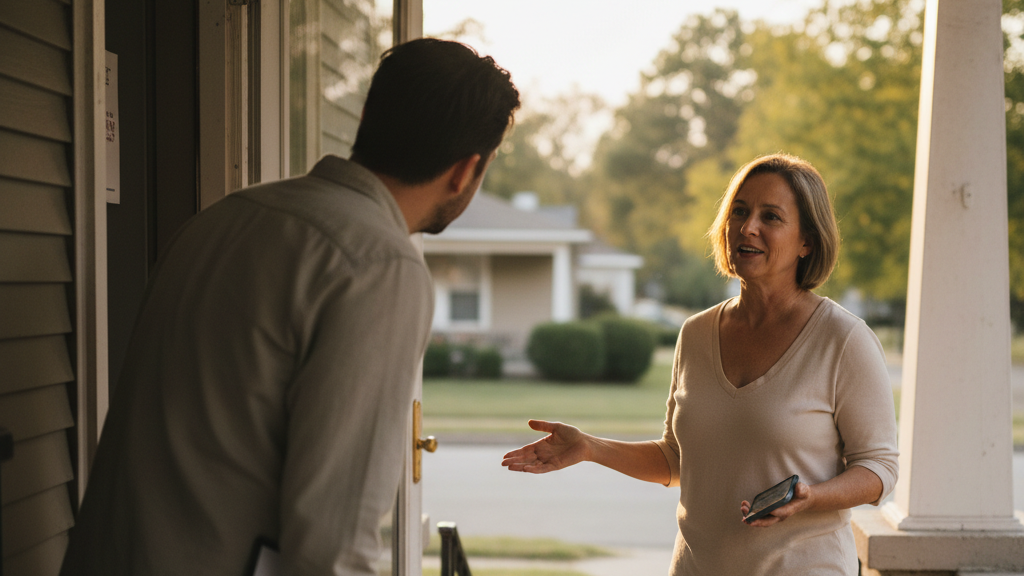
The Conversation Meter Is the Pace Number a Field Program Should Run On
A field-strategy playbook for the conversation meter: the running count of real conversations a campaign steers by, from writing the counting rule to making the mid-shift correction it exists to enable.
Ask a field team how the shift went and you will usually get a door count. It is the easiest number to produce and the most satisfying to say out loud, and what it measures is distance walked. The number that tells a campaign whether the ground game is working is a different one: how many voters the team actually talked to.
That number deserves a name and a spot on the wall. Call it the conversation meter — a single running total of conversations held, watched the way a driver watches a fuel gauge. It is a field discipline that runs on paper or on a phone, and every campaign already has the raw material for one. Most simply never designate the number, so nobody knows mid-shift whether the day is working.
A conversation meter counts real exchanges while the shift is still running
2 properties make the meter useful, and both are easy to lose.
The first is that it advances only on exchanges. A knock with no answer is effort; a resident who opens the door, hears the reason for the visit, and says something back is a conversation. The meter moves on the second event.
The second is currency. A number you assemble on Sunday night from paper walk lists is a report. A number that is roughly current while volunteers are still in the field is a control. The whole value of the meter is that it can change the shift it is measuring.
Write down what counts as a conversation before the first door opens
The labels already exist on the launch card; the meter's job is to declare which of them count.
Activate records 4 outcomes at the door — Yes, No, Not Home, Skip — and a paper walk list resolves to the same 4 in the end. Skip is the catch-all for a refusal, a safety call, or a door a volunteer could not complete. Follow-up rides along as a flag on the response, "Revisit later," rather than as an outcome of its own. Pick the labels that represent a real exchange and declare them the counting set:
- Counts: Yes, No. Someone answered and the campaign's ask was actually raised.
- Does not count: Not Home, Skip. Effort is logged, and the meter waits for the exchange.
Say it out loud at the briefing and put it on the launch card. If a volunteer has to guess whether a 15-second doorstep brush-off is a No or a Skip, your meter is measuring volunteer judgment instead of voter contact. The broader case for separating attempt, contact, conversation, and follow-up is worked through in measuring conversations rather than door knocks; the conversation meter is what you do with that separation while the shift is live.
Work backward from the cycle goal to get a shift target you can read
A running total means nothing without a line to run against. Build the line by division, not by instinct.
Work through a hypothetical school-board campaign — Lakeview Ward 7, run by a manager named Nolan Morphett. The campaign sets a goal of 1,200 conversations before Election Day. There are 8 weeks left and the team runs 2 canvass shifts a week. That is 16 shifts, so 75 conversations per shift. With 6 volunteers on a typical Saturday, the per-canvasser target is roughly 13.
Those figures are Lakeview's own arithmetic — a goal divided by a calendar — and your campaign's line will land somewhere else. The first 3 shifts are what tell you whether 1,200 was a realistic goal or a wish. If the meter consistently lands at 45 when the line says 75, the campaign has learned something far more useful than a disappointing shift — it has learned that the goal, the turf density, or the shift count needs to change while there is still calendar left to change it.
Post the target where the team can see it. A meter steers only when everyone knows the number.
Read the meter at the halfway mark, while the shift can still change
The midpoint check is where the discipline pays for itself.
At roughly the halfway point of the shift, the field lead compares the running total against the pace line. Ahead or on pace, the answer is to leave everyone alone and let them work. Behind, there is still an hour or 2 in which something can be done about it.
This is the part where the tooling earns its place. In Activate, canvassers record each touch on their own phone, and the manager's live dashboard keeps itself current through the shift — no end-of-day report, no ringing 6 volunteers to ask how it is going. The manager can course-correct while the shift is still on. Read the response breakdown rather than the headline number: the headline counts touches, which includes Not Homes and Skips, while Yes plus No is your meter. The dashboard is part of free core canvassing; the metered pieces are SMS, AI column-mapping at import, secure data-package handling, and campaign messaging past the first 100 messages, each priced and shown before you confirm.
A meter behind pace has 3 answers: denser turf, better timing, a shorter opening
Each one is a change the field lead can make before the shift ends.
Move the turf. Contact rates tend to track housing density and access. A route of single-family homes on large lots usually yields fewer answered doors in the same stretch of time than a compact block does, and a building with a locked lobby yields almost none. Shifting a volunteer to denser turf mid-shift is often the largest single lever.
Move the timing. A weekday 2 p.m. block and a Saturday 11 a.m. block are different populations at home. If the meter is behind and it is early afternoon, the honest read may be that the last hour of the shift is worth more than the current one — and that the schedule, not the team, needs fixing next week.
Shorten the opening. Long introductions convert answered doors into polite exits. If contact is fine but conversations are not, the script is where to look. Get to a genuine question before the resident has to decide whether to stay.
Every one of those moves adjusts the plan, which is precisely the meter's job: it is a diagnostic for the plan. Recognition for volunteers has its own instrument — Activate's dashboard carries a canvasser leaderboard for exactly that. Keep the 2 jobs apart, because a field lead who ranks people by the meter invites inflated labels, and an inflated meter reads worse than no meter at all.
Keep the meter honest by holding the definition steady all cycle
1 number, 1 definition, unchanged from the first shift to the last. That constraint is what makes week 7 comparable to week 1.
Log the context alongside the total — date, turf type, volunteer count, weather, script version — because a meter reading of 60 on a rainy Tuesday in low-density turf and a 60 on a clear Saturday in an apartment block are not the same result. Context is what makes the comparison mean anything.
Resist adding a second headline number. Campaigns that crowd a whiteboard with metrics end up steering by none of them. Contact rate, follow-up rate, and data completeness all matter, and they belong in the weekly review — the disciplined version of that review is laid out in the first 100 conversations. During the shift there is room for exactly 1 gauge.
What the meter gives back after a few weeks
The first thing a campaign notices is that debriefs get shorter. When the number is already known, the conversation moves straight to what volunteers heard.
The second is that the calendar starts telling the truth. A meter running at 60% of pace for 3 weeks is arithmetic, and it surfaces early enough to add a shift, tighten the universe, or revise the goal.
The third is quieter and matters most. Volunteers who see conversations counted understand that the campaign values the exchange at the door. That is the behavior a field program actually wants, and a meter is simply the campaign saying so in a number everyone can read.
¿Listo para comenzar la campaña?
Prepara tu campaña y empieza a tocar puertas en minutos. No se requiere tarjeta de crédito. Activate. ¡Hacia la victoria!
Iniciar Campaña Gratis