Multilingual Canvassing That Listens: A Mixed-Language Volunteer Team on 1 Campaign
A translated script is not automatically a translated conversation — here is what actually changes for a field program when the app opens in English or Spanish on each volunteer's own phone, where the boundary sits at your script and your voter list, and which 3 briefing lines make a mixed-language shift run cleanly.
Updated September 6, 2026
In Activate's demo campaign, Nolan Morphett has 11 volunteers in a rec-center back room and a turf list for Lakeview Ward 7.
Niara Switch grew up 4 blocks from the first street on that list and does her best work in Spanish. Ora Cyrene and most of the room are comfortable in English. Nevin Cipher speaks a 3rd language fluently, which is why the last 2 buildings on the route are his. Every one of them can hold a good conversation at a door.
The question is whether the software will let them start. An interface available only in English quietly converts a bilingual volunteer into a translator of button labels — and the person who knows the block ends up shadowing the person who knows the app.
Your team's languages and your app's languages are 2 different lists
Separate these before anything else, because campaigns routinely merge them and then plan around the wrong one.
The first list is the conversation. It is as long as your team is broad, it changes with every person you recruit, and no software vendor sets it. A volunteer who greets a resident the way that resident greets their own neighbors is doing something no product ships.
The second list is the interface — the buttons, labels, and prompts on the phone in the volunteer's hand. Activate's interface ships in English and Spanish.
Most of the friction campaigns blame on "language" lives in the second list and is solved in a briefing line. The first list is a recruiting question, and it is the one that decides how the shift actually goes.
Each volunteer picks their language on their own phone
On first open, the app follows the language the phone reports — behind a stored choice the volunteer made earlier on that phone, and behind a language already carried in the web address. A volunteer whose phone is set to Spanish sees Spanish before anyone tells them where the language menu is.
The choice is personal. It changes that volunteer's screen only: campaign data, the manager's view, and every teammate's screen stay exactly as they were. 2 canvassers can work the same route from different menus and never know it.
For a volunteer whose strongest language is neither English nor Spanish, the app opens in English — a few dozen interface words to learn once, and then the rest of the shift belongs to the conversation. That is a real limit, and it is worth saying plainly in the briefing rather than discovering it at the first door.
The interface list grows on demand, not on supply
A translation vendor will happily sell you a menu of languages. That menu is not a field decision.
Activate is a US canvassing tool, and its interface languages are chosen the way you would choose turf — from demand you can point at. Spanish is the language with a clear case in US field programs today, so it is the one that ships beside English. The alternative — a longer menu where half the screens drop back to English mid-task — is worse than an honest single-language screen, because it breaks trust exactly when a volunteer is under pressure at a door.
Language choices are instrumented, so the next addition is a measured decision rather than a guess. If your program needs a language that is not there yet, say so — a named campaign in the field is the evidence that moves it.
The language follows the volunteer from the QR code into the first assignment
A manager shares 1 QR code or link per campaign role, and volunteers join on their own phones with no app-store download. The invite arrives before anyone has opened a menu, which makes the join screen the first place a language setting matters — and the join screen already follows the volunteer's own device language. So does the assignment list they land on next: a volunteer who joins in Spanish picks up their first assignment in Spanish.
Worth noting for planning: shared invite codes expire 30 days after they are created, and a manager can replace a code if it travels somewhere unintended. Replacing it stops the old link and QR code immediately, per role, and everyone who already joined stays on the team list.
The manager's dashboard collects the whole shift, whatever language it was worked in
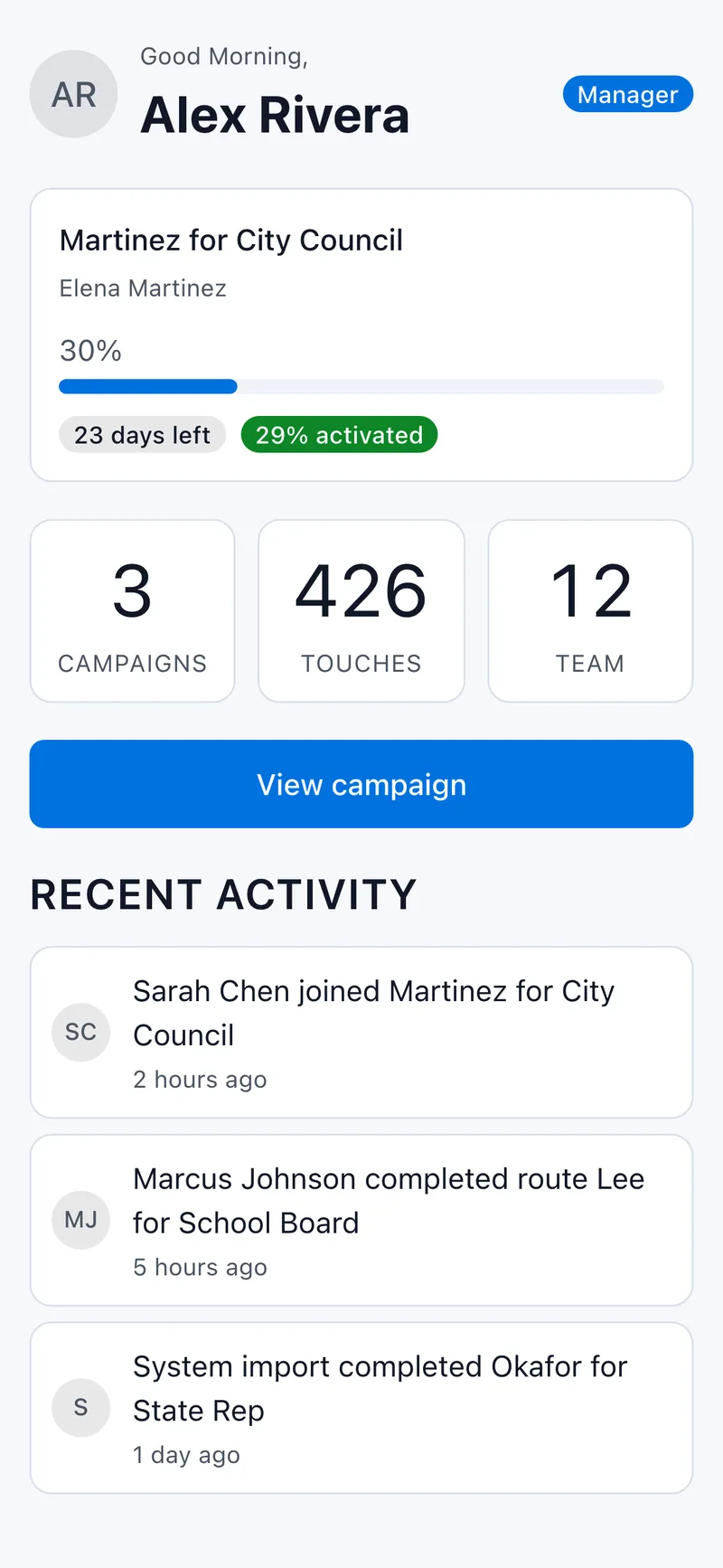
Nolan opens the dashboard in English; he could open it in Spanish and see the same numbers. Niara's afternoon and Ora's arrive as the same kind of record, because language is a display choice sitting on top of a single shared campaign.
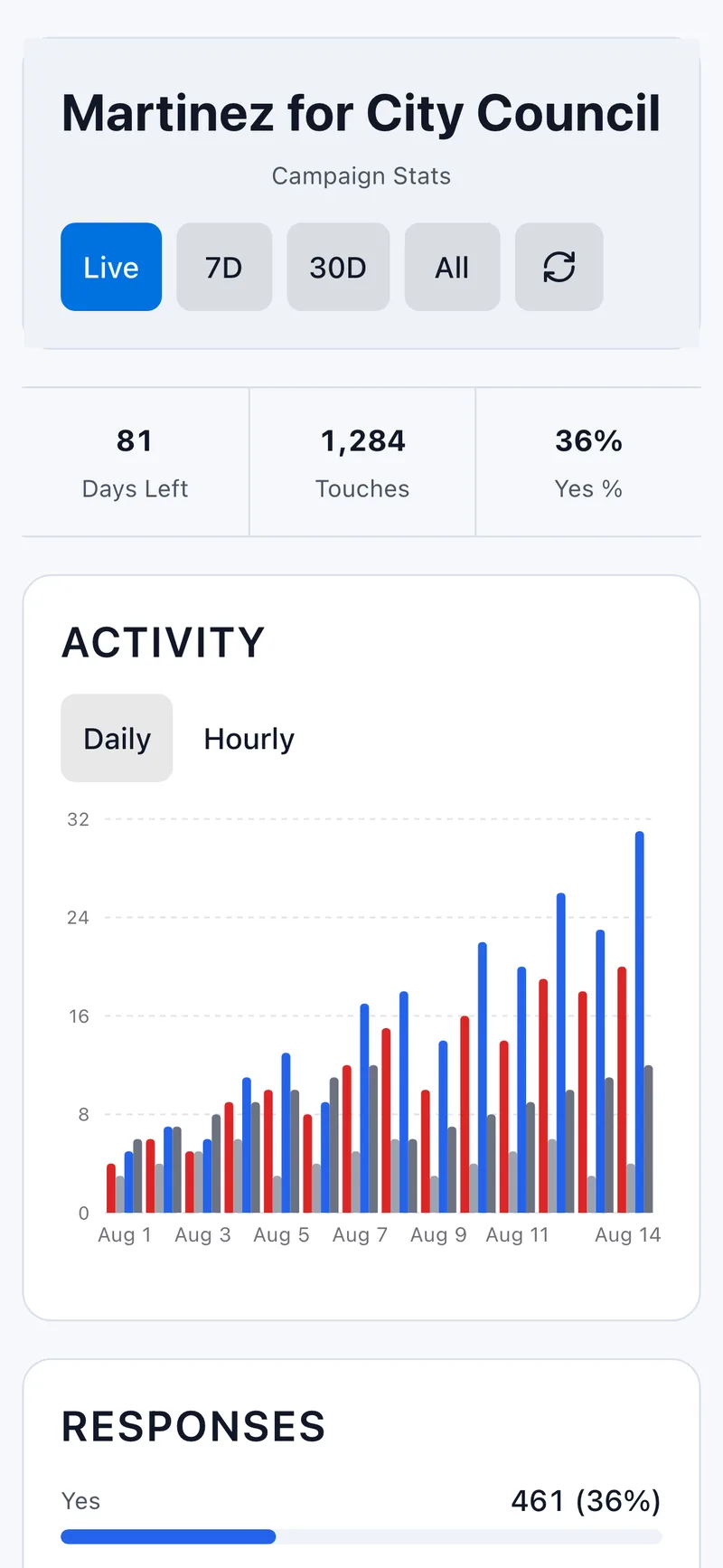
The dashboard keeps itself current through the day without a manual refresh, so a manager can course-correct while the shift is still on rather than waiting for an end-of-day report. What he sees is completion and response activity by route and by person — the same view he would have with a single-language team.
Route assignment underneath is deterministic and has no AI in it. Addresses are normalized and grouped, so an apartment building becomes a single stop group, then sorted by ZIP, city, street, house number, and unit and chunked into routes at a manager-set size — 40 stops by default. The sort prefers keeping a block contiguous over hitting an exact route count. Teammates can join the same route and claim individual stops, which is how a pair splits a building without stepping on each other.
A translated script is not automatically a translated conversation
Activate translates the app, not your campaign. Your script, your talking points, and the voter records you import stay exactly in the language you wrote and imported them. Say that plainly to your team, because it sets expectations correctly on the part that matters most.
The gap it leaves is the interesting one, and it is not a software gap
- The words can be accurate while the greeting lands wrong.
- A volunteer can be fluent in conversation and still not have the vocabulary for a zoning question or a registration deadline.
- A strong first conversation can still fail when the follow-up you promised comes back in a language the resident does not read.
None of that is fixed by a translated button. It is fixed by writing a short opener in each language your team actually canvasses in, rehearsing the 2 or 3 places meaning usually breaks, and deciding who handles follow-up before anyone promises it. The interface is the easy half; the conversation is your homework, and it is where the returns are.
Practical consequence for recruiting: recruit for the conversation and let the interface follow. The volunteer who knows the block is worth more than the volunteer who knows the app.
The languages are part of free core canvassing, so the cost question is short
Adding a second language to your team changes no setting and costs nothing. The interface, the QR invites, unlimited canvassers, route generation, and the live dashboard sit inside free core canvassing, with no credit card required to start. A campaign whose team gets more linguistically mixed on Saturday morning pays what it paid on Friday.
What costs money is metered and disclosed before you confirm it — SMS at 5¢ per segment, AI-assisted column mapping at 10¢ per import, and campaign-internal messaging at 1¢ per message after the first 100 in a campaign. Every verified account receives 25 Credits once, after email verification. Managers can use them for AI import, secure-package overage, and messaging beyond the free tier; SMS requires purchased Credits. The pricing page carries the current rates.
Fold 3 language checks into the launch you already run
Settle language before anything else at your next launch — it takes 1 line in the briefing:
- Tell volunteers to set their language in the menu the moment they join, before the first assignment loads, and tell anyone whose language is not in the menu that their screens will be in English.
- Define your response labels in the languages your team is working in, so "Undecided" means the same thing on every phone. Shared meaning comes out of your briefing, not out of a translation.
- Run a test record with a volunteer working in Spanish and confirm the result reaches the dashboard, exactly as you would test any other part of the setup.
That is the whole addition. It slots into the connect-the-team step of a 30-minute canvass launch without adding a step of its own.
What multilingual canvassing actually buys a field program
The gain shows up in recruiting. Your pool becomes everyone who can hold a conversation on that turf — not everyone who can hold a conversation and read your software.
The volunteer who knows the block, knows the building's side entrance, and can start a conversation the way a resident starts one is the volunteer you want on that turf. Give them an interface that gets out of the way from the invite forward, and the shift starts on the work.
The best volunteer is not always the best English speaker. The software's job is to make that irrelevant to who gets to help.
Ready to start canvassing?
Set up your campaign and start canvassing in minutes. No credit card required. Activate. Toward Victory!
Start Free Campaign