
More Than Elections: How to Run a Petition Drive Door to Door
Plan a signature drive backwards from the threshold, keep the legal sheet apart from your field record, and reuse the method for any community cause.
Door-to-door work belongs to far more than political campaigns. A neighborhood association asking about a park, a nonprofit explaining a new service, and a committee gathering signatures for a ballot measure all face the same Saturday morning: a stack of addresses, a handful of volunteers, and a short window to reach people.
Activate began as a tool for candidates. Its civic and community programs exist because the work of reaching people one door at a time does not stop at elections, and the organizers doing that work kept asking for it. This guide starts with the most demanding version of that work, a petition drive, and then shows how the same method carries over to causes with no deadline at all.
A petition drive is a canvass with a hard number at the end
Every petition has a threshold: a count of valid signatures that must reach the clerk by a filing deadline. Your state or local election office publishes the rules that matter: who may circulate, who may sign, which form to use, how signatures are witnessed, and when the petition is due. Read them before the first shift, because a drive that misses a rule loses signatures it already collected.
That threshold changes how you plan. A candidate's canvass measures conversations. A petition drive measures one outcome, and it can measure it backwards from the deadline.
Plan the drive backwards from the signatures you need
Start with 3 numbers you can know on day 1, then add 2 you will learn after your first shift.
| Signature target | The official threshold, plus a cushion for signatures the clerk may not accept |
| Days left | Your filing deadline, minus the days you need to review and submit |
| Shifts per week | How many volunteer shifts you can staff |
| Answer rate | Doors answered ÷ doors knocked, from your own first shift |
| Signing rate | Signatures ÷ conversations, from your own first shift |
The cushion matters because some signatures fail review: a signer outside the jurisdiction, a duplicate, an illegible line. Your election office or an experienced circulator in your area can tell you how much margin local drives usually carry. Plan for it rather than discovering it at filing.
After the first shift, the arithmetic becomes simple. Divide the signatures you still need by your signing rate to get the conversations you need. Divide that by your answer rate to get the doors. Divide the doors by the days left, and you have a daily pace your team can check every evening.
Use your own rates, not anyone else's. A drive in apartment buildings on a weekday evening and a drive in single-family homes on a Saturday afternoon will produce different numbers, and the only rates that predict your drive are the ones it produces. Our guide to the conversation meter explains how to read a pace number without fooling yourself.
Keep the conversation record separate from the signature
The signed petition sheet is the legal document. Everything else your team records is working information that helps you plan.
Keeping those 2 apart protects the drive in 3 ways
- Nothing on the sheet depends on the app. The petition form follows the rules your election office sets. Your field records never substitute for it.
- A Yes is an answer, not a signature. When a volunteer records that a resident agreed to sign, that is a planning signal. The count that matters at filing is the count of valid lines on the sheets.
- Each record keeps one purpose. A signature gathered for a petition is not permission to contact that person for something else. Keep follow-up lists to the people who asked to hear from you.
With that boundary in place, the field record does what it is good at: it tells you which doors still need a visit, which streets are finished, and where the drive is running behind.
One question keeps every answer comparable
A petition canvass works best with a single question every volunteer asks the same way. For example: "We're collecting signatures to put a measure on the ballot. Would you like to read it and sign today?"
In Activate, an organization sets up a civic and community program with its own field question. Each visit records Yes, No, Not Home or Skip, plus notes. Those 4 outcomes map cleanly onto a drive:
- Yes: the resident signed, or asked to. Count it against your pace, then confirm the line on the sheet.
- No: the resident declined. Thank them and move on; the record keeps another volunteer from knocking again.
- Not Home: the household is still open for the next round.
- Skip: the door was not safe or not reachable, or the resident is not eligible to sign. The note says which.
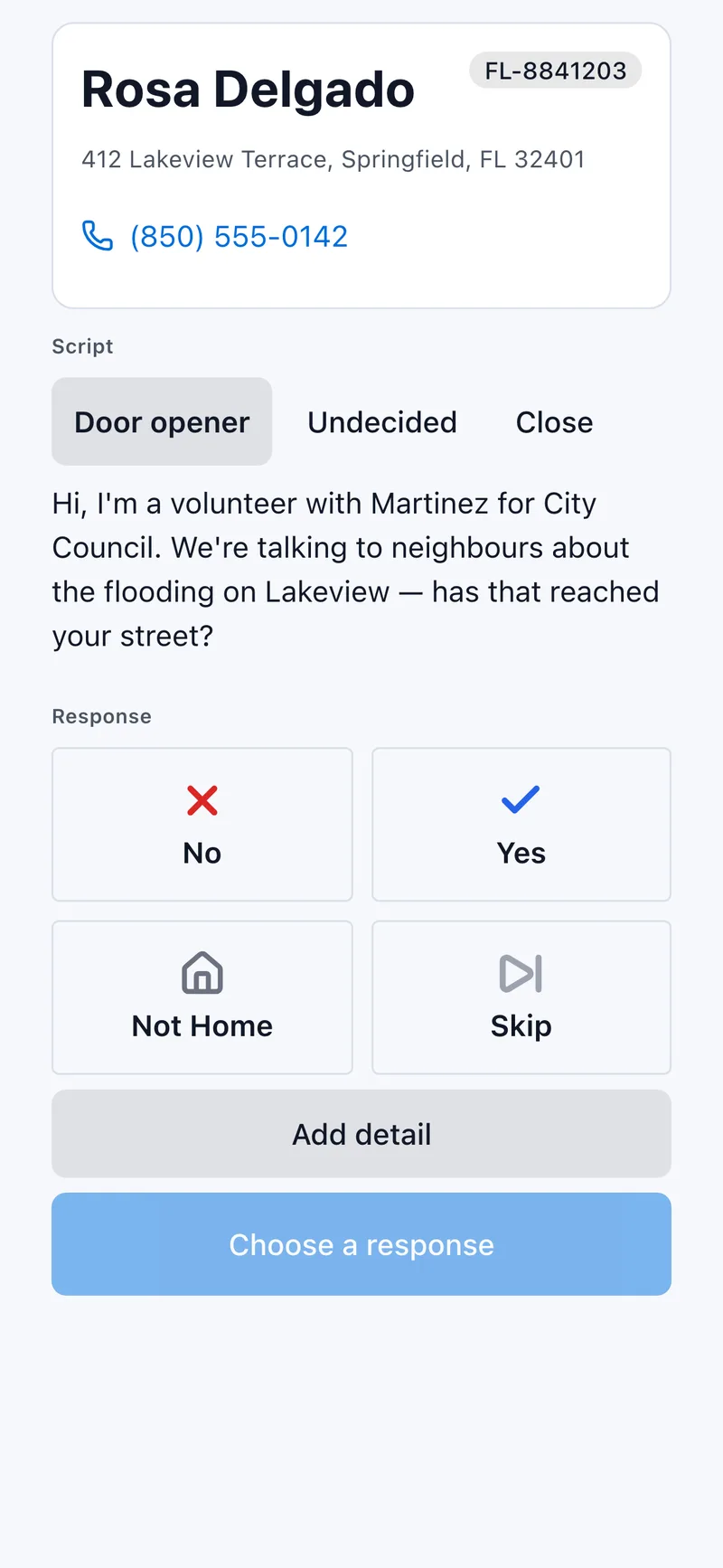
Notes carry what the 4 outcomes cannot: a question the volunteer could not answer, a resident who asked for the measure's full text, a building with a locked entrance.
Volunteers need a 10-minute briefing before every shift
A signature drive puts volunteers in a position a candidate canvass rarely does. They are handling a legal document, and residents ask detailed questions about what they are signing.
Cover 4 things
- What the measure does, in the plain language of the official summary. Volunteers explain the measure; they do not argue it.
- Who may sign, so a volunteer can recognize an ineligible signer politely and record a Skip with a note.
- How the sheet is handled: one signer per line, no corrections by the volunteer, sheets returned at the end of the shift.
- Where unanswered questions go, so a resident who asks something hard gets a real answer later rather than a guess now.
Invite volunteers with a QR code. Activate splits nearby stops across the team so nobody knocks the same door twice, and the manager dashboard updates as the team works.
The evening review is where a drive is won
At the end of each shift, compare 3 counts: signatures on the returned sheets, Yes answers in the field record, and doors knocked. If the sheets and the Yes count drift apart, find out why that night. A volunteer may be recording Yes before the resident signs, or sheets may be going home in someone's bag.
Then update the pace. If the drive is behind, you have 3 levers: more shifts, different times of day, or denser neighborhoods. Your own answer rate by shift time tells you which one to pull. The end-of-shift debrief is a 10-minute routine that keeps those decisions grounded in what the team actually saw.
Export the program's data as CSV whenever you need it for your own records or the next round of visits. Not Home households are your next shift's list.
The same method serves causes with no deadline
Most community canvassing has no filing date. A neighborhood association asking residents what would make a park more useful is still running a canvass: one clear question, volunteers who ask it the same way, and a record of what people said.
The petition method carries over almost entirely. Keep one question per program. Separate what residents told you from what you decide to do about it. And treat doorstep answers as what they are: the views of the people who opened their doors, not a survey of the whole neighborhood.
More than just elections
Elections are one way people take part in their community. Petitions, park improvements, school projects and service programs are others, and nearly all of them start with someone knocking on a door and listening.
We built Activate for that work, and the organizers using it keep showing us where it reaches next. If your group is planning a drive or a listening canvass, setting up a program is the first step; core canvassing is free, and texting and voter data use Credits you see before you confirm.
¿Listo para comenzar la campaña?
Prepara tu campaña y empieza a tocar puertas en minutos. No se requiere tarjeta de crédito. Activate. ¡Hacia la victoria!
Iniciar Campaña Gratis